
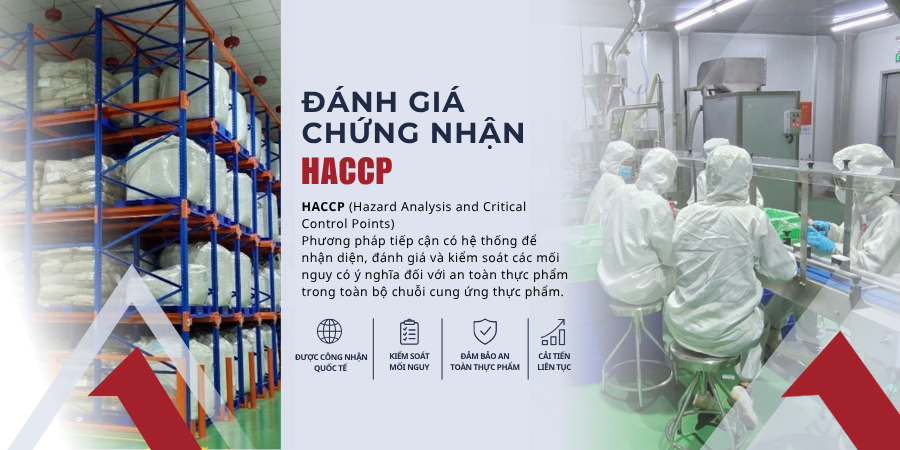
WHAT IS HACCP?
HACCP (Hazard Analysis and Critical Control Point) is a food safety management system based on the principles of hazard analysis and critical control points (CCPs), developed by the Codex Alimentarius Commission and widely applied around the world.
The objective of HACCP is to identify, evaluate, and control hazards that may affect food safety, including:
- Biological hazards (bacteria, viruses, molds, parasites)
- Chemical hazards (pesticide residues, cleaning chemicals, heavy metals, etc.)
- Physical hazards (metal fragments, glass, hard plastics, foreign objects, etc.)
Unlike traditional end-product inspection, HACCP focuses on preventing risks throughout food production, processing, storage, and distribution rather than detecting defects only in the finished product.
The HACCP system is built upon seven core principles:
- Conduct hazard analysis
- Determine Critical Control Points (CCPs)
- Establish critical limits for each CCP
- Establish CCP monitoring procedures
- Establish corrective actions
- Establish verification procedures
- Establish documentation and record-keeping procedures
HACCP is widely applied in industries such as food manufacturing, beverage production, seafood processing, agricultural products, processed foods, food service, and the food supply chain.
WHAT IS HACCP CERTIFICATION?
HACCP certification is an independent assessment conducted by a certification body to verify that an organization's food safety management system has been established, implemented, and maintained in accordance with the HACCP principles of the Codex Alimentarius.
Upon successful completion of the assessment and fulfillment of all applicable requirements, the organization is awarded a HACCP Certificate, demonstrating its capability to control food safety hazards throughout food production, processing, storage, and distribution.
Note: HACCP is a preventive food safety management system, whereas HACCP certification is independent third-party evidence confirming that the organization has effectively implemented and maintained the HACCP system in accordance with internationally recognized requirements.
WHICH ORGANIZATIONS NEED HACCP CERTIFICATION?
HACCP is suitable for organizations involved in the food supply chain.
✓ Food processing plants
✓ Beverage manufacturers
✓ Seafood processing facilities
✓ Agricultural product processors
✓ Bakery and confectionery manufacturers
✓ Meat and poultry processors
✓ Restaurants and institutional kitchens
✓ Food storage facilities
✓ Food logistics companies
✓ Food distribution companies
✓ Food exporters
HACCP is particularly required or preferred by customers, supermarkets, retail chains, and business partners as evidence of an organization's food safety management capability.
WHEN SHOULD A BUSINESS OBTAIN HACCP CERTIFICATION?
✓ To effectively control food safety hazards
✓ Before supplying products to supermarkets and retail chains
✓ To meet customer requirements in domestic and international markets
✓ Before expanding into export markets
✓ To strengthen food safety management
✓ To reduce the risk of complaints and product recalls
BENEFITS OF HACCP CERTIFICATION
► Effective control of food safety hazards
HACCP enables organizations to identify and control biological, chemical, and physical hazards that may affect food safety.
► Enhanced customer confidence
Implementing HACCP demonstrates the organization's commitment to providing safe food products that meet specified requirements.
► Meeting customer and market requirements
Many customers, retail chains, and business partners require food businesses to implement HACCP or an equivalent food safety system.
► Supporting export activities
HACCP is recognized by many international markets and customers as a fundamental food safety management system, making it easier for businesses to satisfy export requirements.
► Reducing production defects and losses
Effective control of critical production stages helps minimize nonconforming products, reduce recalls, and lower operational costs.
► Improving management effectiveness
Clearly defined responsibilities, control methods, and documented records contribute to greater consistency and operational efficiency.
HOW DOES HACCP MAKE A DIFFERENCE?
HACCP is more than a certification. It enables organizations to establish a preventive food safety management system, reduce risks, and strengthen their competitive advantage.
HACCP CERTIFICATION PROCESS AT KMRA
The HACCP certification process at KMRA consists of eight main steps.
Certification
Registration
Application
Review
Audit Program
Planning
Stage 1
Audit
Stage 2
Audit
Technical Review
& Decision
Certificate
Issuance
Surveillance &
Recertification
Step 1: Certification Application & Request Acceptance
The organization provides information regarding:
- Scope of activities
- Types of food products
- Number of employees
- Locations where the system is implemented
Step 2: Certification Application Review
KMR VN reviews:
- Certification scope
- HACCP system information
- Conditions for conducting the audit
Step 3: Audit Program & Planning
The audit program is developed based on the organization's scope of activities, complexity, number of sites, and applicable requirements to ensure a comprehensive and effective audit.
Step 4: Stage 1 Audit
- Review HACCP documentation
- Assess system readiness
- Identify areas requiring improvement
Step 5: Stage 2 Audit
Evaluate the practical implementation of the HACCP system.
The audit covers:
- Prerequisite Programs (PRPs)
- Hazard Analysis
- Critical Control Points (CCPs)
- Monitoring and verification records
- Effectiveness of the HACCP system
Step 6: Technical Review & Certification Decision
Audit results are independently reviewed to:
- Ensure impartiality
- Confirm conformity
- Make the certification decision
Step 7: Certification Issuance
The HACCP Certificate is issued once the organization has met all applicable requirements.
Step 8: Surveillance Audits & Recertification
During the certification cycle, periodic surveillance audits are conducted to verify that the organization:
- Maintains the HACCP system
- Continues effective hazard control
- Continuously improves its food safety performance
At the end of the certification cycle, a recertification audit is conducted to renew the certificate.
HOW LONG DOES IT TAKE TO OBTAIN HACCP CERTIFICATION?
The time required to achieve HACCP certification generally ranges from 2 weeks to 2 months, depending on the organization's size, maturity of its food safety management system, number of processes, certification scope, and implementation capability.
|
Organization Size |
Typical Timeframe |
|
Fewer than 50 employees |
2 weeks – 2 months |
|
50–200 employees |
1–3 months |
|
More than 200 employees |
3–6 months |
Factors affecting the certification timeline include:
- Maturity of the documented system
- HACCP implementation experience
- Number of operating sites
- Production scale
- Internal audit results and corrective actions
- Coordination between the organization and the certification body
HACCP CERTIFICATION COST
The cost of HACCP certification depends on:
- Number of employees
- Number of operating sites
- Product category
- Complexity of production processes
- Certification scope
- Audit duration
Since each organization has unique operational characteristics and certification requirements, quotations are prepared based on the organization's actual information.
CONTACT KMRA FOR A QUOTATION WITHIN 24 HOURS
KMRA will provide advice on the certification scope, audit duration, and certification costs appropriate to your organization's size.
GET A QUOTATION
WHY CHOOSE KMRA?
✓ Audits Based on HACCP Codex Principles
Certification programs are conducted in accordance with internationally recognized HACCP Codex principles to ensure impartiality and credibility.
✓ Extensive Experience in Food Safety
KMR VN has supported numerous organizations engaged in food production, processing, storage, and distribution.
✓ Experienced Auditors
Our audit team has extensive practical experience across a wide range of food sectors.
✓ Nationwide Support
Certification services are available throughout Vietnam.
✓ Value Beyond Certification
KMR VN goes beyond conformity assessment by helping organizations strengthen their food safety management capabilities.
KEY FIGURES
- 10+ years of certification and auditing experience in Vietnam.
- 1,000+ organizations certified through management system certification and conformity assessment programs.
- 100+ auditors and trainers.
- 100+ standards and training programs across multiple industries.
CERTIFIED CLIENTS
More than 1,000 organizations have placed their trust in us.
Representative Industries
- Processed Foods
- Beverages
- Seafood
- Agricultural Products
- Bakery & Confectionery
- Meat & Poultry
- Food Logistics
- Food Service
HACCP Certification Audit at OLAM
FREQUENTLY ASKED QUESTIONS (FAQ)
1. How long is a HACCP certificate valid?
A HACCP certificate is generally valid for three (3) years from the date of issue.
2. How soon is the certificate issued after the audit?
Typically within 1–2 weeks after the audit is completed and corrective actions (if any) have been satisfactorily closed.
3. Is HACCP mandatory by law?
It depends on the product category, industry sector, and the requirements of regulatory authorities or target markets.
4. Is HACCP internationally recognized?
Yes. HACCP is based on the Codex Alimentarius principles and is widely recognized worldwide.
5. Can small businesses implement HACCP?
Yes. HACCP is suitable for both small and large organizations throughout the food chain.
6. What is a CCP in HACCP?
A Critical Control Point (CCP) is a step where control can be applied to prevent, eliminate, or reduce a food safety hazard to an acceptable level.
7. What is the difference between HACCP and ISO 22000?
ISO 22000 is a comprehensive food safety management system standard that incorporates HACCP principles together with management system requirements.
8. Is an internal audit required before certification?
Yes. Internal audits help identify areas for improvement before the certification audit.
9. Can an organization implement HACCP on its own?
Yes, provided it has sufficient resources and technical expertise.
10. What are Prerequisite Programs (PRPs)?
PRPs are the basic environmental and operational conditions necessary to maintain a safe food production environment.
11. Can certification be granted if nonconformities are found?
Corrective actions must be implemented and verified before certification can be granted.
12. Is recertification required after three years?
Yes. A recertification audit is required to maintain certificate validity.
13. Can a HACCP certificate be suspended or withdrawn?
Yes, if the organization fails to maintain system effectiveness or comply with surveillance requirements.
14. Does HACCP support export activities?
Yes. HACCP is recognized by many international customers and markets as a fundamental food safety management system.
15. What is the greatest value of HACCP?
The greatest value of HACCP lies not in the certificate itself, but in its ability to prevent hazards, ensure food safety, and reduce operational risks.
KMRA – HACCP CERTIFICATION PARTNER FOR VIETNAMESE BUSINESSES
KMR VN supports organizations in building customer confidence, meeting market requirements, and strengthening food safety management through HACCP certification services.