
WHAT IS ISO 45001:2018?
ISO 45001 is the international standard for Occupational Health and Safety Management Systems (OH&S) published by the International Organization for Standardization (ISO). The standard enables organizations to identify and control occupational health and safety hazards, reduce the risk of workplace injuries and occupational illnesses, and provide a safe and healthy working environment for employees.
WHAT IS ISO 45001:2018 CERTIFICATION?
ISO 45001:2018 certification is an independent assessment conducted to verify that an organization's Occupational Health and Safety Management System conforms to the requirements of the ISO 45001 standard. Certification helps organizations improve risk management capabilities, comply with occupational health and safety legislation, protect workers, and strengthen confidence among customers and business partners.
ISO 45001:2018 requires organizations to determine their organizational context, identify occupational health and safety hazards and risks, evaluate opportunities for improvement, establish OH&S objectives, implement appropriate control measures, monitor performance, and continually improve the effectiveness of the management system.
ISO 45001 is based on the following core management principles:
- Worker participation and consultation
- Hazard identification and risk control
- Compliance with legal and other requirements
- Risk- and opportunity-based thinking
- Continual improvement
Unlike traditional safety approaches that focus primarily on responding to incidents, ISO 45001 emphasizes a preventive approach through:
- Workplace hazard identification
- Occupational risk assessment and control
- Integration of health and safety into business operations
- Active participation of workers in safety management
- Continual improvement of the OH&S Management System
The standard is based on the Plan-Do-Check-Act (PDCA) cycle and the High-Level Structure (HLS), making it easy to integrate with ISO 9001 and ISO 14001.
WHO NEEDS ISO 45001?
ISO 45001 is suitable for any organization with employees that is committed to providing a safe and healthy workplace.
✓ Manufacturing companies
✓ Construction companies
✓ Mechanical engineering and fabrication companies
✓ Logistics and warehousing companies
✓ Power and energy companies
✓ Mining companies
✓ Chemical companies
✓ Engineering service providers
✓ Hospitals and healthcare organizations
✓ Organizations requiring occupational health and safety management
WHEN SHOULD AN ORGANIZATION OBTAIN ISO 45001 CERTIFICATION?
✓ To reduce workplace accidents and occupational incidents
✓ To comply with occupational health and safety legislation
✓ To participate in tenders requiring an OH&S Management System
✓ To become a supplier to multinational corporations and FDI companies
✓ To establish a strong safety culture
✓ To integrate with ISO 9001 and ISO 14001
BENEFITS OF ISO 45001 CERTIFICATION
► Reduced Workplace Accidents and Occupational Illnesses
The management system enables organizations to proactively identify hazards, assess risks, and implement effective control measures to prevent workplace accidents and protect employee health.
► Compliance with Legal Requirements
ISO 45001 helps organizations systematically identify and comply with applicable occupational health and safety legislation, reducing the risk of non-compliance and regulatory penalties.
► Improved Productivity
A safer workplace minimizes operational disruptions caused by accidents, reduces absenteeism and employee turnover, and improves overall organizational performance.
► Meeting Customer and Business Partner Requirements
Many customers, multinational corporations, and investment projects require suppliers to maintain ISO 45001 certification as evidence of effective occupational health and safety management.
► Enhanced Corporate Reputation
ISO 45001 certification demonstrates an organization's commitment to employee health, workplace safety, and corporate social responsibility, strengthening confidence among customers, partners, and other interested parties.
► Continual Improvement
Through internal audits, incident investigations, management reviews, and continual improvement programs, organizations can continuously enhance the effectiveness of their Occupational Health and Safety Management System.
Internationally Accredited ISO 45001:2018 Certification – KMRA
ISO 9001 & ISO 45001 Certification Audit at Cam Corporation Vietnam
HOW DOES ISO 45001:2018 MAKE A DIFFERENCE?
ISO 45001 is more than a certification. It enables organizations to establish a structured Occupational Health and Safety Management System, proactively prevent workplace accidents, protect employees, strengthen regulatory compliance, and improve overall business performance.
|
Content |
Organizations with ISO 45001 |
Organizations without ISO 45001 |
|
Occupational Health & Safety |
Systematic hazard identification and control |
Reactive approach after incidents occur |
|
Occupational Risks |
Regularly assessed and controlled |
Difficult to identify and prevent risks |
|
Legal Compliance |
Systematically monitors and complies with legal requirements |
Higher risk of non-compliance |
|
Workplace Accidents |
Reduced risk of accidents and incidents |
Greater likelihood of workplace accidents |
|
Employees |
Improved worker participation and safety awareness |
Inconsistent safety awareness among employees |
|
Customers & Business Partners |
Enhanced credibility and confidence |
Difficult to demonstrate OH&S management capability |
|
Project Tendering |
Better positioned to meet client and tender requirements |
May face limitations in tender participation |
|
Operational Performance |
Reduced disruptions caused by accidents and incidents |
Higher risk of operational losses and corrective costs |
|
Safety Culture |
Builds a sustainable safety culture |
Lacks a structured approach to safety management |
|
Continual Improvement |
Established processes for evaluation and continual improvement |
Limited data and methods to support improvement |
ISO 45001 CERTIFICATION PROCESS
The ISO 45001 certification process at KMRA consists of 8 key steps:
Certification
Registration
Application
Review
Audit Program
Planning
Stage 1
Audit
Stage 2
Audit
Technical Review
& Decision
Certificate
Issuance
Surveillance &
Recertification
Step 1: Certification Application
The organization provides information including:
- Scope of activities
- Number of employees
- Locations where the management system is implemented
- Level of occupational health and safety risks
This information is used to develop an appropriate audit program.
Step 2: Application Review
KMRA reviews information including:
- Certification scope
- Information related to the Occupational Health and Safety Management System
- Applicable legal and regulatory requirements
- Conditions for conducting the certification audit
The objective is to determine the certification scope and develop an appropriate audit plan.
Step 3: Audit Program and Audit Planning
The audit program is developed based on the organization's scope of activities, complexity, number of locations, and the requirements of ISO 45001:2018 to ensure a comprehensive and effective certification process.
Step 4: Stage 1 Audit
The organization's Occupational Health and Safety Management System is assessed for readiness through:
- Review of documented information
- Evaluation of hazard identification and risk assessment processes
- Verification of initial system implementation
- Identification of issues requiring corrective action before the Stage 2 Audit
Step 5: Stage 2 Audit
The audit team evaluates the practical implementation of the management system to determine conformity with the requirements of ISO 45001:2018.
The audit includes:
- Hazard identification and risk control activities
- Compliance with occupational health and safety legal requirements
- Records, documented information, and objective evidence
- Worker participation and consultation
- Effectiveness of the OH&S Management System
Step 6: Technical Review & Certification Decision
The audit results are independently reviewed to:
- Ensure impartiality
- Verify compliance with certification requirements
- Make the certification decision
Step 7: Certification Issuance
ISO 45001:2018 certification is granted once the organization has met all requirements of the standard and successfully completed any required corrective actions.
Step 8: Annual Surveillance Audit & Recertification
During the three-year certification cycle, KMRA conducts periodic surveillance audits to confirm that the organization:
- Maintains its Occupational Health and Safety Management System
- Continues to effectively control occupational hazards and risks
- Complies with ISO 45001 requirements and applicable legislation
- Continually improves occupational health and safety performance
HOW LONG DOES IT TAKE TO ACHIEVE ISO 45001 CERTIFICATION?
The time required to achieve ISO 45001 certification typically ranges from 1 to 6 months, depending on the organization's size, occupational health and safety risk level, management system readiness, and certification scope. For most small and medium-sized organizations, implementation and certification generally take 2 to 4 months.
|
Organization Size |
Typical Timeframe |
|
Fewer than 50 employees |
1–3 months |
|
50–200 employees |
2–4 months |
The actual timeframe depends on the maturity of the Occupational Health and Safety Management System (OH&S), the effectiveness of hazard identification and risk control, and the organization's readiness before the certification audit.
Factors affecting the certification timeline include:
- Maturity of OH&S documentation and records
- Hazard identification and occupational risk assessment
- Previous experience with ISO implementation or safety management systems
- Number of employees and operating locations
- Internal audit results and corrective actions
- Compliance with occupational health and safety legislation
- Coordination between the organization and the certification body
Organizations with an established safety management system, effective risk control procedures, and complete legal compliance documentation can significantly shorten the implementation and certification process.
Organizations that have not yet conducted risk assessments, developed safety control procedures, or fully complied with occupational health and safety regulations generally require additional time to establish an effective management system.
In addition, broader certification scopes, larger workforces, or higher occupational risk levels may require longer on-site audit durations and extended preparation time.
ISO 45001 CERTIFICATION COST
Certification costs depend on:
- Occupational risk level
- Number of employees and work shifts
- Number of operating sites
- Industry sector
- Scope of the OH&S Management System (OHSMS)
- Required audit duration
Contact KMRA to receive a quotation within 24 hours.
KMRA will recommend the appropriate certification scope, audit duration, and certification cost based on your organization's size and operational requirements.
GET A QUOTATION
WHY CHOOSE KMRA?
✓ Certification in Accordance with International Requirements
Certification programs are conducted in accordance with internationally recognized requirements to ensure impartiality, transparency, and the credibility of certification results.
✓ Over 10 Years of Certification Experience in Vietnam
KMRA is built on the strong foundation of KMR Vietnam, with more than a decade of experience in management system certification.
✓ Highly Experienced Auditors
Our auditors possess extensive practical experience across manufacturing, services, logistics, food, automotive, electronics, and many other industries.
✓ Nationwide Support
Certification services are available throughout Vietnam.
✓ More Than Just a Certificate
KMRA not only assesses conformity but also supports organizations in their journey of continual improvement and sustainable development.
KEY FIGURES
- 10+ years of experience in certification and conformity assessment in Vietnam
- 1,000+ organizations certified through management system certification and conformity assessment programs
- 100+ auditors and trainers
- 100+ standards and training programs across multiple industries
CERTIFIED CLIENTS
Trusted by more than 1,000 organizations
Representative industries include:
• Construction|• Mechanical Engineering & Manufacturing|• Logistics & Warehousing|• Electronics|• Energy|• Food|• Mining|• Industrial Manufacturing|• Engineering Services
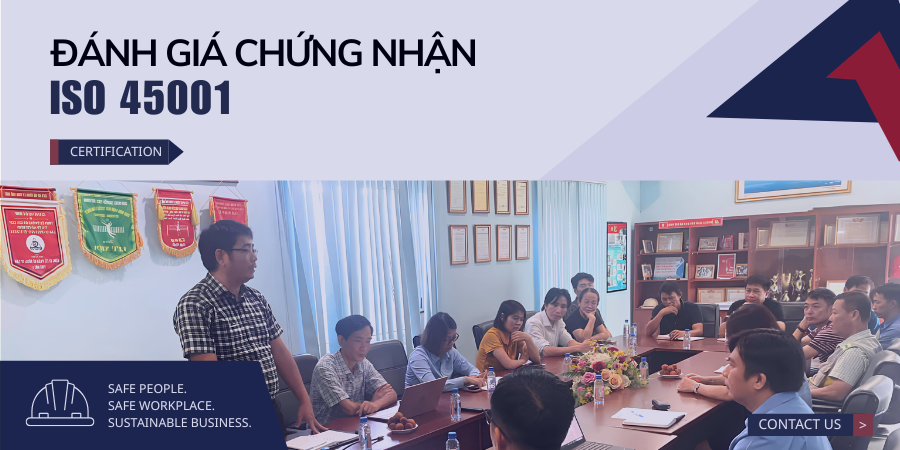
ISO 45001 Certification Audit at Ly Tam Concrete
FREQUENTLY ASKED QUESTIONS (FAQ)
1. Does ISO 45001 really help reduce workplace accidents?
Yes, but the benefits come from implementing an effective risk management system rather than simply obtaining a certificate. ISO 45001 shifts the organization from a reactive approach to a proactive, preventive approach through hazard identification and risk assessment.
2. How does ISO 45001 differ from legal compliance?
Legal requirements establish the minimum mandatory obligations. ISO 45001 goes beyond compliance by requiring a structured management system with monitoring, measurement, internal audits, and continual improvement.
3. Can an organization implement ISO 45001 without an HSE department?
Yes. ISO 45001 does not require a dedicated HSE department, but it does require clearly defined OH&S roles and responsibilities throughout the organization.
4. Is ISO 45001 suitable for service organizations?
Yes. Occupational risks exist not only in manufacturing but also in offices, logistics, healthcare, engineering services, and other service environments.
5. Why does ISO 45001 require worker participation?
Workers are directly exposed to workplace hazards and provide valuable practical information for identifying and controlling risks.
6. Will ISO 45001 create excessive bureaucracy for small organizations?
No. The standard requires an effective management system that is appropriate to the organization's size and level of occupational risk—not unnecessary documentation.
7. Can ISO 45001 be integrated with ISO 9001 and ISO 14001?
Yes. All three standards follow the High-Level Structure (HLS), allowing organizations to implement an Integrated Management System (IMS).
8. Does the certification audit focus on documents or actual practice?
The primary focus is on on-site implementation. Documents serve as supporting evidence, while auditors evaluate workplace conditions, safety practices, and risk controls.
9. Can an ISO 45001-certified organization still experience accidents?
Yes. ISO 45001 does not guarantee zero accidents. It ensures that risks are managed systematically and that effective corrective and continual improvement processes are in place.
10. Does ISO 45001 require safety performance measurement?
Yes. Organizations are required to establish and monitor OH&S performance indicators such as accident rates, near misses, PPE compliance, and other safety metrics.
11. Can the certificate be suspended or withdrawn?
Yes. Certification may be suspended or withdrawn if the organization fails to maintain conformity or does not meet surveillance audit requirements.
12. Does ISO 45001 apply to subcontractors?
Yes. Organizations may either require subcontractors to comply with their OH&S Management System or implement equivalent safety controls.
13. What determines the effectiveness of ISO 45001 implementation?
Its effectiveness depends on three key factors: leadership commitment, worker participation, and the quality of on-site risk control.
14. Can ISO 45001 reduce workers' compensation or insurance costs?
Potentially, in the long term, through reduced accidents and improved safety performance. However, certification itself does not automatically reduce insurance premiums.
15. Should ISO 45001 be implemented before or after business expansion?
Ideally before or during expansion, as the system helps identify and control occupational risks from the planning and operational stages.
KMRA – THE ISO 45001:2018 CERTIFICATION PARTNER FOR VIETNAMESE BUSINESSES
KMRA is built upon more than 10 years of experience in management system certification in Vietnam. We support organizations across manufacturing, construction, logistics, mechanical engineering, electronics, energy, and service industries in creating safer workplaces, protecting employee health, and improving operational performance.
With a team of highly experienced auditors, KMRA helps organizations implement and achieve ISO 45001:2018 certification by effectively controlling occupational health and safety hazards, reducing workplace accidents, complying with legal requirements, and meeting customer and stakeholder expectations.
ISO 45001 certification is more than proof of compliance—it demonstrates an organization's commitment to workplace safety, sustainable development, corporate responsibility, and operational excellence while strengthening competitiveness and stakeholder confidence in both domestic and international markets.
KMRA is committed to providing impartial, transparent, and internationally recognized certification services, supporting organizations on their journey toward safer workplaces and sustainable growth.