
WHAT IS ISO 14001?
ISO 14001 is the international standard for Environmental Management Systems (EMS) published by the International Organization for Standardization (ISO). It provides a framework that enables organizations to identify, control, and reduce the environmental impacts arising from their manufacturing, business, and service activities.
The current version, ISO 14001:2015, is applicable to organizations of all sizes and sectors. The standard focuses on continually improving environmental performance, complying with applicable legal and regulatory requirements, and supporting sustainable development.
Implementing ISO 14001 helps organizations effectively manage environmental aspects such as waste, wastewater, emissions, energy consumption, resource utilization, and other environmental risks associated with their operations.
The standard specifies requirements for establishing, implementing, maintaining, and continually improving an Environmental Management System to help organizations:
- Control environmental aspects
- Reduce environmental impacts
- Fulfil compliance obligations
- Drive continual improvement of environmental performance
ISO 14001:2015 is based on the Plan-Do-Check-Act (PDCA) cycle and a risk-based approach, ensuring that environmental management activities are systematic, consistent, and effective.
Its core principles include:
- Life cycle perspective
- Process approach
- Risk and opportunity management
- Continual improvement
WHAT IS ISO 14001 CERTIFICATION?
ISO 14001 certification is an independent confirmation that an organization's Environmental Management System has been established, implemented, and maintained in accordance with the requirements of ISO 14001.
To obtain certification, an organization undergoes an independent audit conducted by a certification body to verify conformity with the standard and the effectiveness of its environmental management practices.
ISO 14001 certification not only enhances credibility with customers, business partners, and regulatory authorities, but also demonstrates a strong commitment to environmental protection and sustainable development. It is a valuable competitive advantage for organizations participating in tenders, exporting products, or becoming suppliers to domestic and international corporations.
An ISO 14001 certificate is generally valid for three (03) years and is maintained through annual surveillance audits.
WHO NEEDS ISO 14001 CERTIFICATION?
ISO 14001 is widely applicable to any organization that creates or manages environmental impacts.
✓ Manufacturing companies
✓ Construction companies
✓ Logistics and warehousing companies
✓ Energy sector organizations
✓ Chemical companies
✓ Food and beverage manufacturers
✓ Engineering service providers
✓ Industrial parks and export processing zones
✓ Government agencies and public organizations
ISO 14001 is particularly important for organizations participating in global supply chains, FDI projects, and industries subject to stringent environmental compliance requirements.
WHEN SHOULD AN ORGANIZATION OBTAIN ISO 14001 CERTIFICATION?
✓ When operations have significant environmental impacts
✓ When customers or business partners require certification
✓ To reduce operational costs
✓ To comply with environmental regulations
✓ To strengthen brand image and reputation
✓ When implementing other ISO management system standards
BENEFITS OF ISO 14001:2015 CERTIFICATION
► Environmental Impact Control
Helps organizations identify and control environmental aspects such as emissions, wastewater, solid waste, and resource consumption.
► Environmental Legal Compliance
Provides a systematic approach to identifying and fulfilling applicable environmental legal and regulatory requirements.
► Reduced Environmental Risks
Risk-based thinking helps minimize environmental incidents, accidents, and non-compliance.
► Resource Optimization
Encourages efficient use of energy, raw materials, and natural resources while reducing waste throughout operations.
► Enhanced Corporate Reputation
Certification demonstrates environmental management capability and strengthens confidence among customers, business partners, and international stakeholders.
► Access to Global Supply Chains
Many multinational corporations require ISO 14001 certification as a prerequisite for supplier qualification.
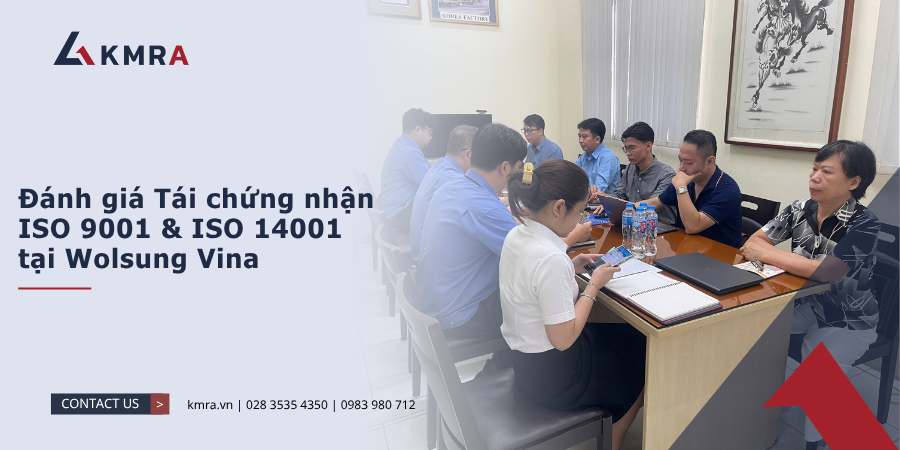
ISO 9001 & ISO 14001 Recertification Audit at Wolsung Vina
HOW DOES ISO 14001 MAKE A DIFFERENCE?
ISO 14001 is more than a certification. It enables organizations to establish an effective Environmental Management System, reduce environmental risks, comply with legal requirements, improve resource efficiency, and strengthen their reputation as a sustainable and responsible business.
|
Content |
Organizations with ISO 14001 |
Organizations without ISO 14001 |
Content |
|
Legal Compliance |
Proactively manages and complies with environmental requirements |
Higher risk of non-compliance or overlooking regulatory requirements |
Legal Compliance |
|
Waste Management |
Well-defined procedures for waste segregation and control |
Inconsistent waste management with greater potential for waste and inefficiency |
Waste Management |
|
Resource Utilization |
Optimizes the use of energy, water, and raw materials |
High resource consumption with limited control |
Resource Utilization |
|
Environmental Risk |
Proactively identifies and prevents environmental risks |
Often responds only after environmental incidents occur |
Environmental Risk |
|
Corporate Image |
Enhances credibility with customers and business partners |
More difficult to gain a competitive advantage in environmental performance |
Corporate Image |
|
Sustainable Development |
Establishes objectives and continual improvement programs |
Lacks a long-term environmental management strategy |
Sustainable Development |
ISO 14001 CERTIFICATION PROCESS
The ISO 14001 certification process at KMRA consists of 8 key steps designed to evaluate the conformity of an organization's Environmental Management System (EMS) with the requirements of ISO 14001:2015.
Certification
Registration
Application
Review
Audit Program
Planning
Stage 1
Audit
Stage 2
Audit
Technical Review
& Decision
Certificate
Issuance
Surveillance &
Recertification
Step 1. Certification Application & Enquiry
The organization provides information regarding its business activities, organizational size, number of employees, locations where the Environmental Management System (EMS) is implemented, and the desired certification scope. Based on this information, KMRA determines an audit program appropriate to the organization's operations and environmental aspects.
Step 2. Application Review
KMRA reviews the certification scope, environmental aspects and impacts of the organization's activities, applicable legal and regulatory requirements, and the readiness of the Environmental Management System to determine whether certification can proceed and to establish an appropriate audit plan.
Step 3. Audit Program & Planning
The audit program is developed based on the organization's scope of activities, size, complexity of environmental aspects, number of operational sites, and the requirements of ISO 14001:2015 to ensure a comprehensive, effective, and impartial audit process.
Step 4. Stage 1 Audit
The audit team reviews the organization's documented Environmental Management System, including the environmental policy, environmental objectives, environmental aspects assessment, compliance obligations, and related procedures. The purpose is to evaluate the readiness of the management system before the Stage 2 certification audit.
Step 5. Stage 2 Audit
The audit team conducts an on-site assessment through personnel interviews, observation of operational activities, review of records, and collection of objective evidence to verify the effective implementation of the Environmental Management System, the organization's ability to control environmental impacts, and conformity with ISO 14001:2015 requirements.
Step 6. Technical Review & Certification Decision
Following completion of the audit, all audit records and findings undergo an independent technical review to ensure impartiality and transparency before a certification decision is made.
Step 7. Certification
Once the organization has demonstrated conformity with all applicable ISO 14001:2015 requirements and successfully completed any required corrective actions, KMRA issues the ISO 14001 Certificate. The certificate remains valid throughout the certification cycle, and the organization is authorized to use the certification mark in accordance with applicable certification rules.
Step 8. Annual Surveillance & Recertification
During the certification cycle, KMRA conducts periodic surveillance audits to confirm that the Environmental Management System continues to be maintained, improved, and operated in conformity with ISO 14001 requirements. At the end of the certification cycle, a recertification audit is conducted to renew the validity of the certificate.
HOW LONG DOES IT TAKE TO OBTAIN ISO 14001 CERTIFICATION?
The time required to obtain ISO 14001:2015 certification depends on the organization's size, the maturity of its Environmental Management System (EMS), the number of operational sites, and its level of compliance with applicable environmental legislation.
Typical implementation and certification timeframes are as follows:
|
Organization Size |
Typical Timeframe |
|
Fewer than 50 employees |
1–3 months |
|
50–200 employees |
2–4 months |
The actual certification timeframe depends largely on the organization's ability to identify and control environmental aspects and assess environmental risks.
Organizations with well-established systems for waste management, energy management, and environmental legal compliance typically achieve certification more quickly.
Organizations that have not yet identified significant environmental aspects or established environmental monitoring data generally require additional time to develop a complete Environmental Management System.
In addition, industries with higher environmental impacts, such as chemical manufacturing and heavy industry, usually require longer on-site audit durations due to more detailed assessment requirements.
ISO 14001 CERTIFICATION COST
The cost of ISO 14001 certification is not fixed and depends on several factors, including:
- Organization size
- Number of operational sites
- Environmental risk level
- Industry sector
- Scope of the Environmental Management System (EMS)
- Required audit duration
Certification costs are determined following an assessment of the organization's actual circumstances.
CONTACT KMRA FOR A QUOTATION WITHIN 24 HOURS
KMRA will recommend an appropriate certification scope, audit duration, and certification cost based on your organization's size and operational requirements.
GET A QUOTATION
WHY CHOOSE KMRA?
✓ Effective Control of Environmental Impacts
ISO 14001 enables organizations to identify, assess, and control environmental aspects arising from their operations, helping reduce pollution and improve the efficient use of natural resources.
✓ Compliance with Environmental Regulations
The standard provides a systematic approach to identifying, monitoring, and complying with applicable environmental legislation, reducing the risk of regulatory violations and penalties.
✓ Enhanced Corporate Image and Reputation
ISO 14001 certification demonstrates an organization's commitment to sustainable development, environmental protection, and corporate social responsibility, strengthening confidence among customers and business partners.
✓ Greater Competitiveness and Market Access
Many multinational corporations and global supply chains require or give preference to suppliers certified to ISO 14001.
✓ Reduced Operating Costs
By improving the management of energy, raw materials, water consumption, and waste generation, organizations can significantly reduce operating costs.
✓ Continual Improvement and Sustainable Development
Based on the Plan-Do-Check-Act (PDCA) methodology, ISO 14001 promotes continual improvement of environmental performance and management effectiveness.
KEY FACTS
- 10+ years of certification and auditing experience in Vietnam
- 1,000+ organizations certified through management system certification and conformity assessment programs
- 100+ auditors and trainers
- 100+ certification, auditing, and training programs across various industries
CERTIFIED CLIENTS
Trusted by more than 1,000 organizations
Representative industries include:
• Automotive Components |• Logistics |• Food |• Electronics |• Construction|• Information Technology (IT)|• Engineering Services
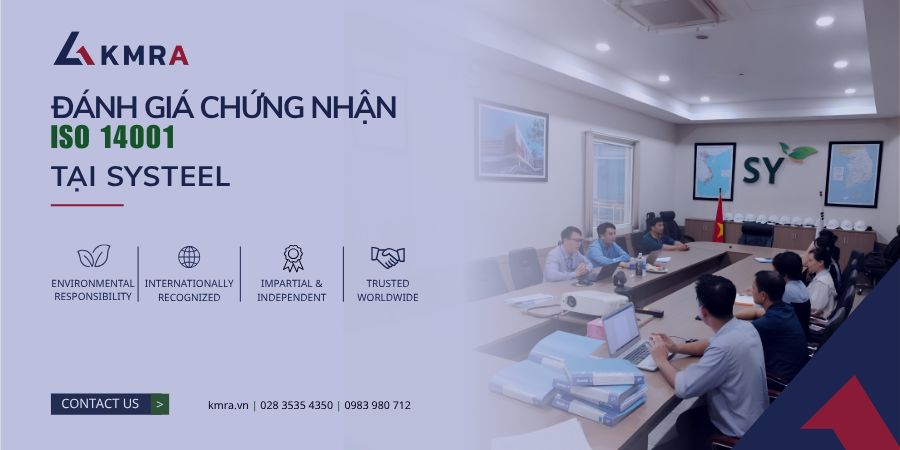
ISO 14001 Certification Audit at Systeel
FREQUENTLY ASKED QUESTIONS (FAQ)
1. Is ISO 14001 mandatory?
No. However, it is frequently required by customers, projects, and global supply chains.
2. Is ISO 14001 suitable for small businesses?
Yes. ISO 14001 is applicable to organizations of all sizes.
3. What is the difference between ISO 14001 and ISO 9001?
ISO 14001 focuses on environmental management, while ISO 9001 focuses on quality management.
4. Can ISO 14001 be integrated with ISO 45001?
Yes. Both standards can be integrated into an Integrated Management System (IMS).
5. Can newly established organizations implement ISO 14001?
Yes. Newly established organizations can implement ISO 14001 by developing an Environmental Management System appropriate to their activities.
6. What is a surveillance audit?
A surveillance audit is a periodic assessment conducted to verify that the Environmental Management System continues to operate effectively and remains compliant with ISO 14001 requirements.
7. Is ISO 14001 internationally recognized?
Yes. ISO 14001 is an internationally recognized standard accepted worldwide.
8. Does ISO 14001 require environmental monitoring?
Yes, where applicable. Monitoring requirements depend on environmental risks and legal obligations. Environmental monitoring forms part of operational control and demonstrates the effectiveness of the EMS.
9. How is ISO 14001 related to environmental legislation?
ISO 14001 requires organizations to establish processes for identifying, monitoring, and complying with all applicable environmental legal and regulatory requirements.
10. Can ISO 14001 reduce operating costs?
Yes. Improved management of energy, materials, and waste can significantly reduce operational costs, although cost reduction is a beneficial outcome rather than the primary objective of the standard.
11. What are the most common implementation weaknesses?
Common weaknesses include incomplete identification of environmental aspects and insufficient quantitative data to evaluate environmental impacts.
12. Does ISO 14001 support export activities?
Yes. Many international customers require suppliers to maintain an Environmental Management System certified to ISO 14001.
13. How is ISO 14001 related to ESG?
ISO 14001 provides a strong technical foundation for the Environmental (E) pillar of ESG (Environmental, Social, and Governance).
14. Can ISO 14001 be integrated with ISO 9001?
Yes. Both standards follow the High-Level Structure (HLS), enabling organizations to implement an Integrated Management System that reduces duplication and improves operational efficiency.
15. What is the greatest value of ISO 14001?
The greatest value of ISO 14001 lies in helping organizations systematically manage environmental impacts using objective data while supporting long-term sustainable development.
KMRA – THE ISO 14001:2015 CERTIFICATION PARTNER FOR VIETNAMESE BUSINESSES
Built upon more than ten years of experience in management system certification in Vietnam, KMRA supports organizations in establishing and maintaining effective ISO 14001:2015 Environmental Management Systems to control environmental impacts, comply with legal requirements, and achieve sustainable development.
With experienced auditors across manufacturing, food, logistics, electronics, construction, chemical, and service industries, KMRA delivers impartial, transparent, and internationally recognized certification services.
ISO 14001 certification not only strengthens an organization's reputation among customers and business partners but also supports more efficient resource utilization, reduces environmental risks, and enhances competitiveness within global supply chains. KMRA is committed to supporting organizations throughout their environmental management and sustainability journey.