WHAT IS FDA?
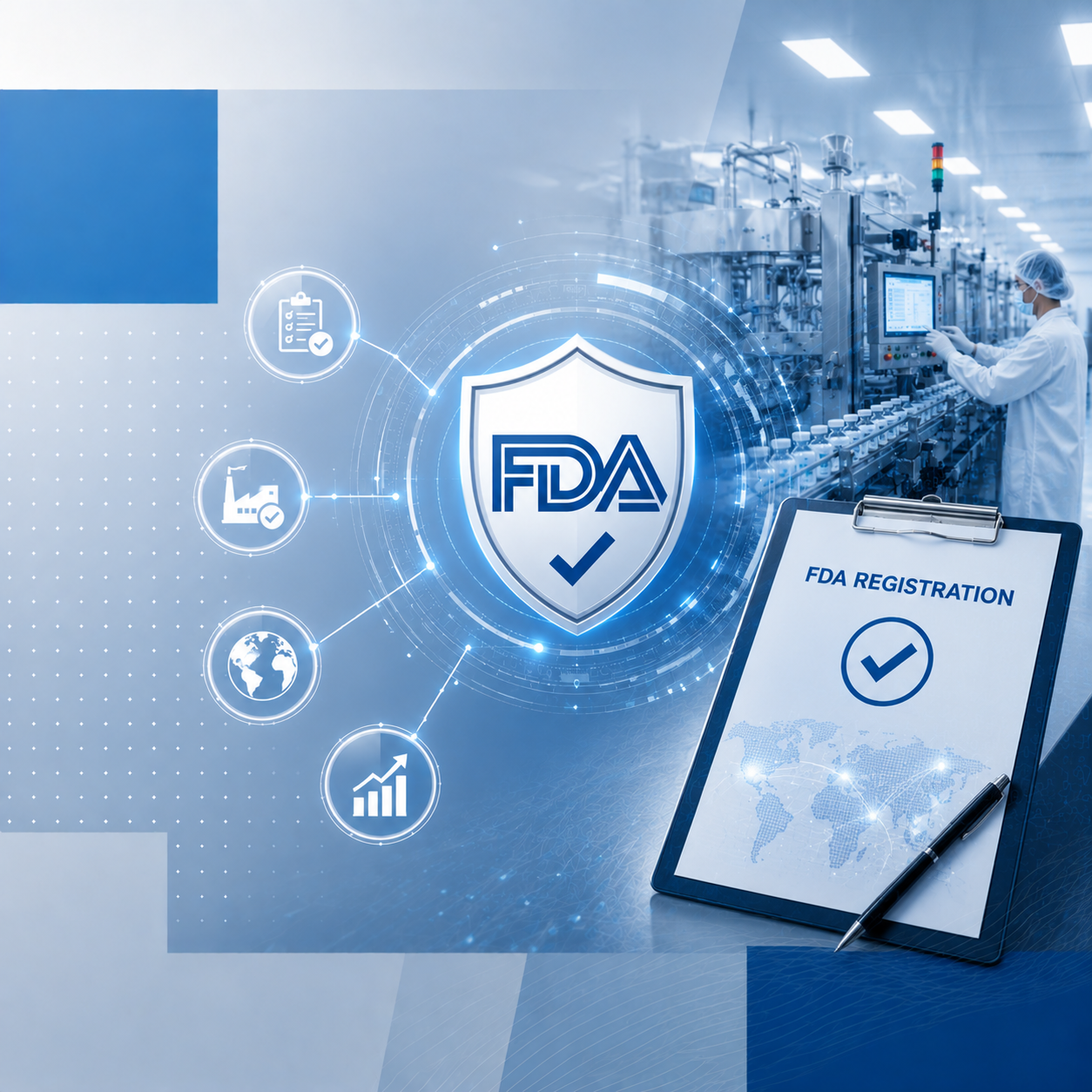
FDA (Food and Drug Administration) is the U.S. Food and Drug Administration, an agency under the U.S. Department of Health and Human Services.
FDA is responsible for protecting public health by regulating and supervising the safety, quality, and effectiveness of food, drugs, medical devices, cosmetics, dietary supplements, and other consumer products marketed in the United States.
Established in 1906, FDA is currently one of the most influential regulatory authorities worldwide. FDA regulations and requirements are widely referenced by many countries and international organizations when developing product safety and quality management systems
WHAT IS U.S. FDA REGISTRATION?
U.S. FDA Registration is the process of registering facilities involved in the manufacturing, processing, packaging, storage, or distribution of products under FDA regulation before placing products on the U.S. market.
Depending on the product category, organizations may be required to complete requirements such as:
- Registration of manufacturing facilities with FDA
- Appointment of a U.S. Agent
- Medical Device Registration
- Product Listing
- FDA approval or authorization procedures for specific product categories
- Compliance with labeling, traceability, and quality documentation requirements
After completing the registration procedures according to FDA requirements, organizations may receive an FDA Registration Number or be recorded in the FDA management system depending on the applicable product category.
WHEN SHOULD ORGANIZATIONS REGISTER WITH FDA?
✓ Before exporting products to the United States
✓ When required by U.S. customers or importers
✓ When participating in supply chains of international brands
✓ When expanding export markets
✓ When improving business credibility and competitiveness
✓ When reducing the risk of import refusal or FDA warnings
Note: FDA requirements vary depending on product categories. Food, cosmetics, dietary supplements, medical devices, and pharmaceuticals may have different registration, notification, or approval requirements.
ROLE AND BENEFITS OF U.S. FDA REGISTRATION
► Meet Legal Requirements for Exporting to the United States
FDA registration is mandatory for many product categories regulated by FDA before entering the U.S. market. Registration helps organizations comply with applicable regulations and minimize legal risks during export activities.
► Facilitate Export Activities
Organizations that complete FDA registration can work more effectively with customers, importers, and U.S. authorities, helping facilitate the process of introducing products into the market
► Enhance Business Reputation and Reliability
FDA registration demonstrates compliance with U.S. regulatory requirements for products and manufacturing facilities, strengthening the organization's reputation among customers and partners.
► Increase Customer and Importer Confidence
Many U.S. importers, distributors, and retailers prioritize suppliers that have completed FDA registration because it is an important requirement for products to be marketed in the U.S.
► Reduce the Risk of Product Detention or Import Rejection
Proper FDA registration helps minimize the risk of products being detained, warned, or rejected at U.S. entry points due to regulatory non-compliance.
► Expand International Market Opportunities
FDA registration not only supports access to the U.S. market but also helps improve competitiveness in other international markets with strict product safety and quality requirements.
► Support Participation in Global Supply Chains
Many multinational corporations, retailers, and international brands require suppliers to comply with FDA regulations. FDA registration increases opportunities to participate in global supply chains.
► Support Sustainable Brand Development
Meeting FDA requirements helps organizations build a professional image, enhance brand value, and establish a strong foundation for long-term export development.
► Increase Market Competitiveness
FDA registration provides an important advantage that differentiates organizations from competitors who have not met U.S. market requirements, especially in industries such as food, cosmetics, dietary supplements, and medical devices.
HOW DOES FDA REGISTRATION CREATE DIFFERENTIATION?
FDA registration is not only an export procedure for entering the U.S. market; it also helps organizations improve compliance capability, increase product credibility, and expand opportunities to access one of the world's largest markets.
|
Criteria |
Organizations with FDA Registration |
Organizations without FDA Registration |
|
Exporting to the United States |
Meet requirements for entering the U.S. market |
Difficult or unable to export products to the U.S. |
|
Regulatory Compliance |
Comply with FDA requirements |
Potential risk of regulatory violations |
|
Customs Clearance |
Smoother import procedures |
Risk of product detention or import rejection |
|
Customers and Importers |
Easier to build trust and cooperation opportunities |
Difficult to meet partner requirements |
|
Business Reputation |
Enhance professional image and credibility |
Difficult to demonstrate compliance capability |
|
International Markets |
Increase opportunities to expand exports |
Limited ability to access international markets |
|
Global Supply Chain |
Easier participation in international supply chains |
Difficult to meet requirements of large corporations |
|
Competitiveness |
Create advantages when approaching new customers |
Limited business opportunities |
|
Quality Management |
Promote product standardization and control |
Lack of foundation to meet international requirements |
|
Brand Development |
Increase brand value and reputation |
Difficult to differentiate in the market |
For many organizations in the food, dietary supplement, cosmetics, and medical device industries, FDA registration is not only a requirement for exporting products to the United States but also evidence of compliance capability and commitment to product quality for international customers.
U.S. FDA REGISTRATION PROCESS AT KMRA
The U.S. FDA registration process at KMRA consists of 5 main steps: receiving registration information, preparing documents, working with a U.S. FDA Agent, completing FDA registration, and receiving registration confirmation.
The implementation timeline depends on the product category, registration scope, and the organization’s document readiness.
Step 1: Receiving Registration Information
The organization provides necessary information according to KMRA’s registration form, including:
- Organization information
- Manufacturing or business location
- Product category for registration
- Export market
- Other relevant information
This information is used to determine applicable FDA requirements and develop an appropriate registration plan.
Step 2: Document Preparation
KMRA guides organizations in preparing necessary documents according to FDA requirements, including:
- Organization legal information
- Manufacturing facility information
- Product list
- Relevant technical documents (if applicable)
The objective is to ensure that the registration dossier is complete and compliant with FDA requirements.
Step 3: Working with a U.S. FDA Agent
For organizations located outside the United States, FDA requires the appointment of a U.S. Agent.
KMRA coordinates with partners and the U.S. FDA Agent to:
- Confirm registration information
- Complete registration documents
- Perform procedures required by FDA
Step 4: FDA Registration Submission
The registration dossier is submitted and processed through the FDA system according to the applicable product category.
The process may include:
- Food Facility Registration
- Medical Device Registration
- Product Listing
- Other FDA procedures depending on the specific industry
Step 5: Receiving FDA Registration Confirmation
After completing the registration process, the organization may receive:
- FDA Registration Number (where applicable)
- Registration confirmation notice
- Related FDA registration records
This serves as evidence that the organization has fulfilled FDA registration requirements when exporting products or working with customers and importers in the United States.
HOW LONG DOES U.S. FDA REGISTRATION TAKE?
The timeline for U.S. FDA registration depends on the type of registration and product category.
When an organization has complete documents, accurate information, and meets relevant requirements, the FDA registration process can usually be completed within a relatively short period.
|
FDA Registration Type |
Reference Timeline |
|
Food Facility Registration |
2–3 days |
|
FDA Registration for Cosmetics |
Approximately 30 days |
|
FDA Registration for Medical Devices |
Approximately 90 days |
The actual timeline may vary depending on:
- Product category being registered
- Completeness and accuracy of documents
- Regulatory requirements applicable to each industry
- Coordination progress between the organization, U.S. Agent, and FDA
- Additional requests or updates from FDA during document processing
For food businesses, registration is often completed quickly when registration information is complete and accurate.
Meanwhile, industries such as cosmetics and especially medical devices generally have more complex regulatory requirements, resulting in longer processing times.
Organizations that prepare complete information from the beginning can significantly shorten registration time and minimize additional issues during the FDA registration process
U.S. FDA REGISTRATION COST
FDA registration costs are not fixed and depend on various factors, including:
✔ Product category being registered (food, cosmetics, dietary supplements, or medical devices)
✔ U.S. Agent requirements (FDA-designated representative in the United States)
✔ Annual fees required by FDA regulations (applicable to certain product categories such as medical devices or pharmaceuticals)
✔ Number of products and labels requiring review and evaluation before registration
✔ Level of document support, consultation, and handling of additional requirements during the registration process
CONTACT KMRA TO RECEIVE A QUOTATION WITHIN 24 HOURS
KMRA will provide consultation on registration scope, implementation timeline, and costs suitable for your organization's requirements.
WHY CHOOSE KMRA?
✓ Assessment Based on International Requirements
KMRA’s certification and registration programs are conducted in accordance with applicable international requirements to ensure objectivity, transparency, and reliability of assessment results.
✓ More Than 10 Years of Experience in Certification and Assessment in Vietnam
KMRA is developed from the foundation of KMR Vietnam’s experience, with more than 10 years of operation in management system assessment and certification.
✓ Experienced Experts with Practical Knowledge
Our team of experts has practical experience in various industries, including manufacturing, services, logistics, food, automotive, electronics, and many other sectors.
✓ Nationwide Support
Assessment, certification, and registration support services are provided for organizations throughout Vietnam.
✓ Value Beyond Certification
KMRA not only evaluates conformity but also accompanies organizations throughout their journey of continuous improvement and sustainable development.
KEY HIGHLIGHTS
- 10+ years of experience in assessment and certification activities in Vietnam.
- 1,000+ organizations have been assessed and certified through various certification and conformity assessment programs.
- 100+ auditors and trainers.
- 100+ standards and assessment/training programs across multiple industries
REGISTERED CLIENTS
More than 1,000+ organizations have placed their trust in KMRA.
Typical customer industries include:
• Food and beverage
• Dietary supplements
• Seafood
• Agricultural products and processed food
• Cosmetics
• Medical devices
• Pharmaceuticals
• Food-contact packaging
• Food ingredients
• Spices and food additives
• Agricultural and seafood export companies
• Food processing and export packaging companie
FREQUENTLY ASKED QUESTIONS (FAQ)
1. What is FDA?
FDA (Food and Drug Administration) is the U.S. Food and Drug Administration, responsible for regulating the safety, quality, and effectiveness of food, cosmetics, dietary supplements, medical devices, pharmaceuticals, and many other products in the U.S. market.
2. Is FDA Registration the same as FDA Certification?
No. FDA does not issue certificates in the same way as ISO 9001 or ISO 22000 certification. The term “FDA Certification” is commonly used in business contexts to refer to the completion of FDA registration procedures or compliance with FDA requirements.
3. Which organizations need U.S. FDA Registration?
Organizations manufacturing, processing, packaging, or exporting food, dietary supplements, cosmetics, medical devices, and other regulated products to the United States generally need to complete FDA registration according to applicable requirements.
4. How long is FDA Registration valid?
The validity period and maintenance requirements depend on the specific FDA registration type. Some programs require organizations to update or renew registration periodically according to FDA regulations.
5. Is a U.S. Agent required?
Yes. For organizations located outside the United States, FDA requires the appointment of a U.S. Agent as the communication contact between FDA and the organization.
6. How long does FDA Registration take?
The implementation timeline depends on the registration type:
- Food Facility Registration: approximately 2–3 days
- Cosmetics Registration: approximately 30 days
- Medical Device Registration: approximately 90 days
The actual timeline may vary depending on document completeness and applicable regulatory requirements.
7. Can organizations export products to the U.S. immediately after FDA Registration?
FDA registration is an important requirement for exporting products to the United States. However, organizations must also comply with other requirements related to products, labeling, import declarations, and applicable industry regulations.
8. Can products be exported to the U.S. without FDA Registration?
For products under FDA regulation, failure to complete required registration procedures may result in products being detained, refused entry, or facing regulatory issues in the United States.
9. Does FDA apply to dietary supplements?
Yes. Dietary supplements are regulated by FDA and must comply with relevant requirements regarding facility registration, product labeling, and other applicable regulations before being marketed in the United States.
10. Does FDA apply to cosmetics?
Yes. Organizations manufacturing or exporting cosmetics to the U.S. market must comply with applicable FDA cosmetic regulations.
11. Does FDA apply to medical devices?
Yes. Medical devices are strictly regulated by FDA and may require facility registration, device registration, or other specialized procedures depending on product classification.
12. Does FDA Registration improve business credibility?
Yes. Meeting FDA requirements helps organizations enhance reputation, increase trust among customers, importers, and international partners.
13. Can newly established organizations register with FDA?
Yes. Newly established organizations can complete FDA registration if they meet applicable requirements for their specific product categories.
14. Does FDA Registration replace ISO or HACCP?
No. FDA is a regulatory requirement of the United States, while ISO 22000, HACCP, GMP, and ISO 9001 are management standards and systems. In many cases, organizations need to comply with both FDA requirements and relevant international standards
15. What is the greatest value of FDA Registration?
The greatest value of FDA Registration is helping organizations legally access the U.S. market, enhance product credibility, build trust with international customers, and expand opportunities to participate in global supply chains.
16. Does KMRA support U.S. FDA Registration?
Yes. KMRA supports organizations by providing FDA requirement consultation, document preparation guidance, coordination with U.S. Agents, and FDA registration procedures suitable for different product categories and export requirements.
KMRA – TRUSTED PARTNER FOR VIETNAMESE ORGANIZATIONS
KMRA is developed from more than 10 years of experience in management system assessment and certification in Vietnam.
We support organizations across various industries, including manufacturing, logistics, food, electronics, construction, and services, in building customer trust, meeting market requirements, and improving competitiveness.
RECEIVE U.S. FDA REGISTRATION QUOTATION FROM KMRA WITHIN 24 HOURS
Contact KMRA for consultation on registration scope, implementation timeline, and costs suitable for your organization's requirements.