
ISO 22000: THE “PASSPORT” FOR FOOD PRODUCTS TO ENTER MAJOR SUPPLY CHAINS?
To introduce a food product into supermarket systems, restaurant chains, processing plants, or export markets, businesses need more than just a good product and competitive pricing. Customers are increasingly asking a more important question: How does the business control food safety?
In this context, ISO 22000 certification is often described as a “passport” that helps businesses demonstrate their food safety management capabilities and establish a foundation for accessing supply chains with stringent requirements.
However, does ISO 22000 actually guarantee that a business will be selected as a supplier? Where does the real value of this certification lie?
What Is ISO 22000?
ISO 22000 is an international standard that specifies requirements for a Food Safety Management System (FSMS). The standard can be applied to organizations of all sizes and at any position within the food chain.
Its scope of application is not limited to food manufacturers or processors. It may also include:
+ Manufacturers of raw materials and food additives;
+ Food and beverage processing establishments;
+ Catering and food service providers;
+ Storage, logistics, and distribution businesses;
+ Manufacturers of food-contact packaging;
+ Suppliers of equipment, cleaning chemicals, and related services;
+ Other organizations directly or indirectly involved in the food chain.
The current version is ISO 22000:2018, which integrates a systems-based management approach, communication throughout the food chain, prerequisite programs (PRPs), and HACCP principles.
The standard has also been supplemented by Amendment 1:2024 on climate action, which requires organizations to consider whether climate change is a relevant issue in the context of their management system.
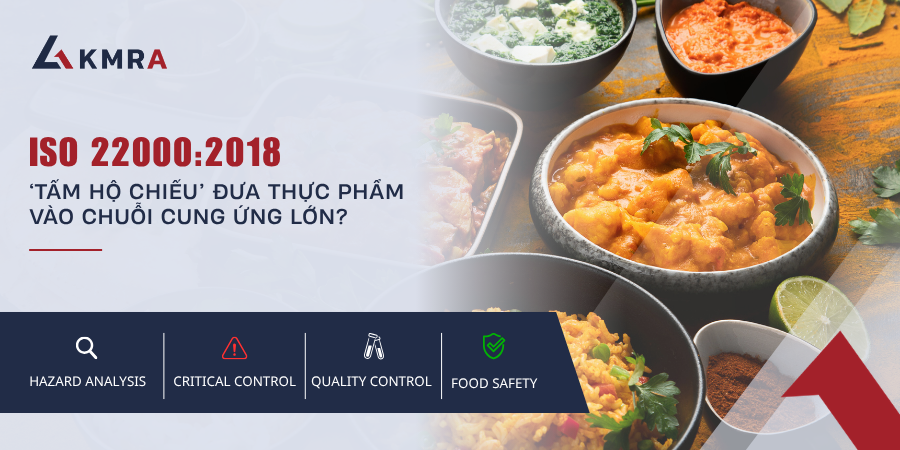
ISO 22000:2018: The “Passport” for Food Products to Enter Major Supply Chains
Why Is ISO 22000 Considered a “Passport”?
When selecting suppliers, major businesses often look beyond the final product. They also assess how suppliers identify hazards, control processes, ensure traceability, and respond to incidents.
A business without a well-established management system may face difficulties in demonstrating that food safety risks are being consistently controlled.
ISO 22000 certification issued by an independent certification body can provide evidence that a business has established and maintained a system that meets the requirements of the standard. This gives businesses a stronger basis to:
- Participate in supplier assessment and selection processes;
- Meet the requirements of business customers;
- Expand into retail systems and distribution networks;
- Access markets with stringent food safety requirements;
- Enhance confidence in commercial transactions;
- Reduce the number of separate assessments conducted by individual customers.
However, it is important to understand that ISO 22000 certification does not automatically guarantee that a product will be accepted by every distribution system. Individual customers and markets may impose additional requirements relating to products, legislation, testing, labelling, traceability, or other certification schemes.
Therefore, the term “passport” should be understood as a foundation for demonstrating management capability, rather than a guarantee that a business will automatically meet every commercial requirement.
What Does ISO 22000 Help Businesses Demonstrate?
1. Food Safety Hazards Are Systematically Controlled
Businesses are required to identify and assess potential hazards that may arise from raw materials, production processes, storage, and distribution.
Common hazards include:
+ Biological hazards, such as bacteria, viruses, and parasites.
+ Chemical hazards, such as chemical residues, cleaning agents, and allergens.
+ Physical hazards, such as metal, glass, and foreign objects.
+ Other hazards associated with the product, technology, and production conditions.
Based on the results of the hazard analysis, businesses establish appropriate control measures through Prerequisite Programmes (PRPs), Operational Prerequisite Programmes (OPRPs), or Critical Control Points (CCPs).
2. Responsibilities Are Clearly Assigned
Food safety is not solely the responsibility of the QA/QC department. ISO 22000 requires the involvement of top management, the food safety team, purchasing, production, warehousing and logistics, maintenance, and other relevant functions.
When responsibilities are clearly defined, businesses can minimize situations where procedures are established but no one is clearly accountable for monitoring and implementing them.
3. Traceable Records and Data
In a modern supply chain, businesses need to be able to determine:
1. Which suppliers the raw materials were purchased from;
2. Which product batches the raw materials were used for;
3. The production and control conditions applicable to each batch;
4. Which customers the products were delivered to;
5. The scope of products that need to be addressed when an incident occurs.
The ability to trace information quickly and accurately enables businesses to identify the scope of risks, limit the extent of product recalls, and reduce potential losses when issues arise.
4. The Business Is Capable of Responding to Incidents
An effective Food Safety Management System (FSMS) cannot operate only under normal conditions. Businesses must also be prepared to respond to situations such as:
Detection of unsafe products;
 Power outages or cold chain disruptions;
Unsafe or inadequate water supply;
Non-conforming raw materials;
Natural disasters or environmental incidents;
Serious customer complaints;
Product recall requests.
Through response plans, traceability exercises, and mock recalls, businesses can assess their ability to respond effectively before an actual incident occurs.
The Value of ISO 22000 Certification in Current Trends
1. Traceability Is Moving Toward Digital Data
Major supply chains increasingly require information on batch codes, suppliers, production processes, and distribution to be retrieved quickly. QR codes, ERP systems, temperature sensors, and data management platforms are gradually replacing fragmented paper-based records.
ISO 22000 does not require businesses to use any specific technology. However, the system must ensure that traceability information is available, accurate, and controlled. Therefore, digital transformation can serve as a tool to help businesses operate their food safety management systems more effectively.
2. Food Safety Culture Is Receiving Greater Attention
Even well-designed procedures can fail if employees do not follow them or are reluctant to report errors. As a result, supply chains today are increasingly looking beyond documentation to assess employee awareness, behavior, and engagement.
Businesses need to move away from the mindset that “food safety is the responsibility of QA” toward a culture in which every employee understands their role in ensuring product safety.
3. Supplier Risks Are Becoming Increasingly Complex
Fluctuations in raw materials, changes in supply sources, logistics disruptions, and climate-related impacts can give rise to new hazards. This requires businesses to assess suppliers based on risk, rather than simply checking licenses or purchase prices.
Implementing an ISO 22000-certified management system helps organizations establish systematic processes for the selection, evaluation, monitoring, and re-evaluation of suppliers.
4. Food Safety Is Increasingly Linked to Resilience
Climate change can affect the availability of raw materials, water quality, storage conditions, pest activity, and microbial growth. Therefore, considering climate change should not be limited to adding a single line to context analysis documentation.
Businesses need to assess its specific impacts on food safety hazards, infrastructure, cold chains, supply sources, and emergency response plans.
Is ISO 22000 Suitable for Small and Medium-Sized Enterprises?
ISO 22000 is not only intended for large manufacturing facilities or export-oriented businesses. The standard allows organizations to develop a system that is appropriate to their size, products, processes, and level of risk.
Small and medium-sized enterprises can implement ISO 22000 in a streamlined manner by:
+ Clearly defining the scope of application;
+ Standardizing only the processes that are necessary;
+ Leveraging existing forms and systems;
+ Focusing resources on significant food safety hazards;
+ Avoiding excessive documentation that does not add value;
+ Providing training based on employees’ actual job responsibilities.
The objective of the system is not to create a large volume of documentation, but to help businesses control food safety consistently and maintain objective evidence of effective implementation.
When May ISO 22000 Not Be Sufficient?
Depending on the target market and customer requirements, businesses may need to meet additional requirements, such as:
Food safety regulatory requirements;
Product declaration or product registration requirements;
Testing and laboratory requirements;
Food labeling regulations;
HACCP requirements;
FSSC 22000, BRCGS, or IFS certification;
Halal, Kosher, or industry-specific standards;
Specific requirements of retail chains and international customers.
Therefore, before choosing a certification, businesses should clearly identify their products, target customers, and target markets. This helps avoid investing in a management system that does not fully address actual commercial and market requirements.
ISO 22000 – More Than a Certification: Demonstrating Supply Chain Readiness
In the food industry, trust cannot be built through advertising alone. Businesses need to demonstrate that food safety is controlled through a responsible system supported by data and continual improvement.
ISO 22000 certification can help businesses standardize their operations, strengthen their credibility, and establish a foundation for accessing customers with more stringent requirements. However, the greatest value of the standard does not lie in the certificate displayed on the wall, but in the ability to control food safety hazards across every product batch and every link in the supply chain.
A “passport” only truly has value when a business has the capability and competence to navigate the journey that follows.
main.comment_read_more