
NATIONAL PRODUCTIVITY AND QUALITY FORUM 2026: FROM PRODUCTIVITY ENHANCEMENT TO RESHAPING GROWTH MODELS THROUGH THE TWIN TRANSITION
On 14 August 2026, the National Productivity and Quality Forum 2026, themed “Accelerating Productivity through Science, Technology, Innovation and Digital Transformation to Advance Viet Nam Towards the 2045 Vision”, brought together experts, policymakers and business representatives to discuss an issue of strategic importance to Viet Nam: how to enhance productivity, quality and competitiveness in a new phase of economic growth.
The attendance and guidance of Deputy Prime Minister Ho Quoc Dung at the Forum underscored the growing importance attached to productivity and quality enhancement and the transformation of the growth model in Viet Nam’s national development strategy. The overarching message was not merely to mobilise additional resources for the economy, but, more importantly, to generate greater value from the same amount of capital, labour, technology and natural resources.
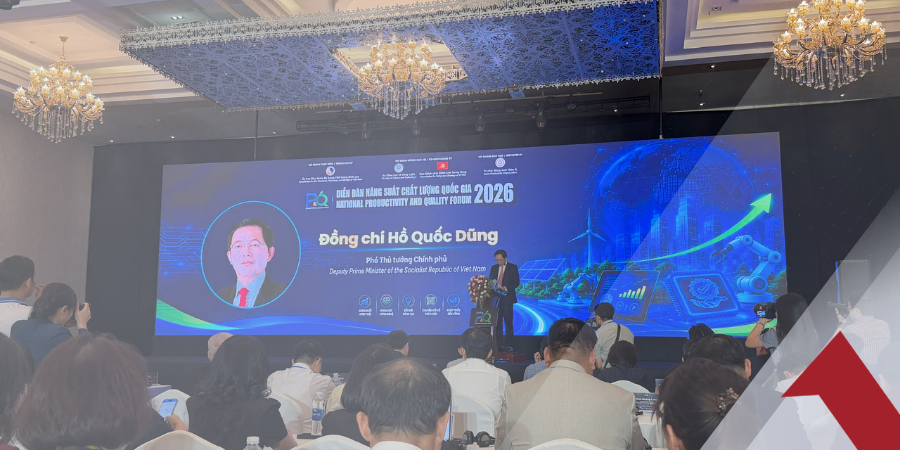
Deputy Prime Minister Ho Quoc Dung delivers his keynote remarks at the Forum.
This direction is also aligned with the National Standards Strategy for the 2026–2035 period, promulgated by Deputy Prime Minister Ho Quoc Dung. The Strategy identifies the national standards system as a component of the national quality infrastructure, contributing to the promotion of innovation, digital transformation, green transition, and improvements in productivity, quality and competitiveness.
From this perspective, two presentations at the Forum offered a broader picture of Viet Nam’s path towards higher productivity: on the one hand, reshaping the growth model; and on the other, harnessing the combined potential of digital transformation, artificial intelligence and the green transition.
I. Reshaping the Growth Model: Not Simply Growing Faster, but Creating Greater Value
In his presentation entitled “Reshaping the Growth Model: The Role of Digital Productivity, Green Growth and Institutions”, Dr Nguyen Duc Hien, Deputy Head of the Central Commission for Policy and Strategy, together with his research team, raised a fundamental question for Viet Nam: “How much more value can be generated from the same amount of capital, labour and natural resources?”
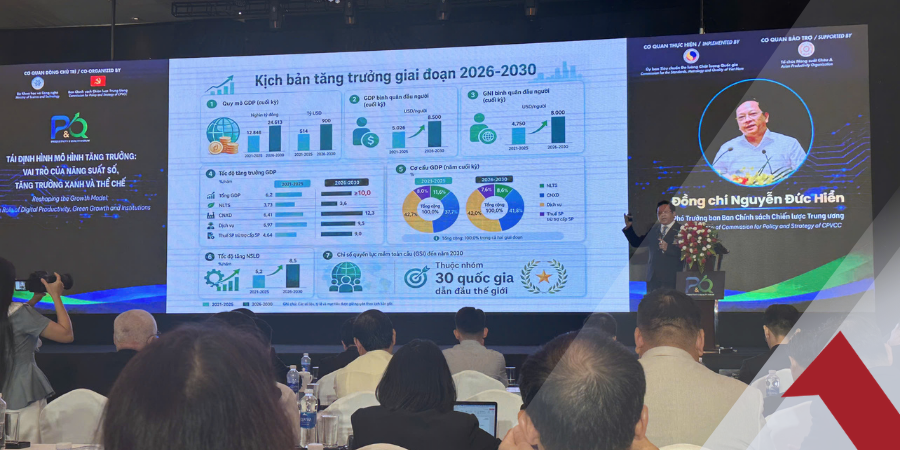
Reshaping the Growth Model for the 2026–2030 Period
This marks a shift from a growth mindset centred on mobilising additional resources towards a productivity-driven approach based on capability enhancement.
According to the presentation, traditional growth drivers such as capital, labour, natural resources and the contract manufacturing model are increasingly showing their limitations. Capital requirements continue to rise, the competitive advantage of low-cost labour is diminishing, natural resources can no longer be treated as “free inputs”, while many of Viet Nam’s key export industries remain concentrated in low-value-added manufacturing activities.
This places Vietnamese enterprises under increasing pressure to rethink how they create value.
Rather than simply expanding their capital base, enterprises need to build capabilities in technology, skills, infrastructure, research and development (R&D), design and high-value-added services. At the same time, they must optimise resource efficiency and promote the development of a circular economy.
Digital Productivity: Moving from “Having Technology” to “Generating Productivity Gains through Technology”
One of the key highlights of the presentation was its approach to digital productivity.
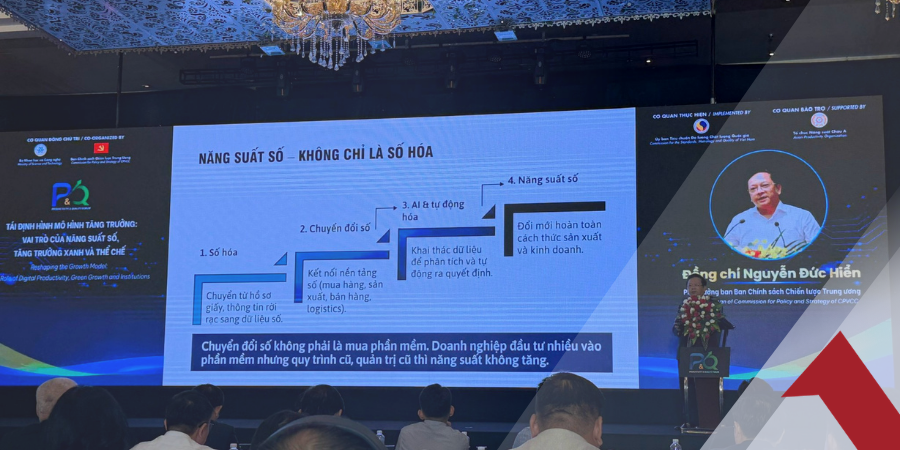
Digital Productivity – More Than Just Digitisation
Digital transformation is not simply a matter of digitising records or purchasing additional software. It is viewed as a four-stage process: digitising data, connecting digital platforms, applying AI and automation, and ultimately transforming the way businesses operate, produce and conduct their activities.
In particular, businesses need to recognise the time lag associated with digital transformation. The initial stages often involve investment costs, training expenses and process disruptions. Productivity gains only begin to materialise when businesses adapt their processes, enhance workforce capabilities and successfully integrate data.
Therefore, Viet Nam’s challenge is not merely to promote widespread technology adoption, but to move from “having technology” to “generating productivity gains through technology” by strengthening businesses’ capacity to absorb and leverage technological advances.
This is also why AI is emerging as a new driver of productivity enhancement. According to the estimates presented at the Forum, higher AI adoption rates are expected to make greater contributions to total factor productivity (TFP), increasing from 0.24 percentage points at an adoption rate of 15% in 2025 to approximately 1.92 percentage points when adoption reaches 90% by 2045.
Green Productivity: When Resource Efficiency Becomes a Competitive Advantage
While digital productivity creates new productive capabilities through data, technology and artificial intelligence, green productivity addresses a different question: how much value can businesses generate from each unit of resources?
Electricity, raw materials, water and carbon are no longer viewed merely as input costs. Instead, they are factors that must be managed to generate greater value while minimising resource consumption. This is the resource productivity approach increasingly adopted by economies around the world.
The presentation also highlighted the significant potential for Vietnamese businesses to improve resource productivity. Enhancing the efficiency of energy, raw material and resource use not only helps reduce emissions but can also lower operating costs and strengthen competitiveness.
Notably, ESG should also evolve from a compliance-driven requirement into an integral part of business operations, risk management and access to finance strategies.
Therefore, productivity enhancement in the new era cannot be separated from the green transition.
II. The Twin Transition: AI-DX × GX as a New Driver of Economic Growth
While Dr Nguyen Duc Hien’s presentation laid the foundation for understanding digital productivity, green productivity and institutional frameworks, the presentation entitled “International Experiences in Overcoming the Middle-Income Trap through the Twin Transition” by Prof. Vu Minh Khuong, PhD, further broadened the discussion to national and international perspectives.
According to Prof. Vu Minh Khuong, Viet Nam is facing four major historical transitions: geopolitical and geo-economic shifts; the digital and AI revolution; the green transition and circular economy; and innovation.
Against this backdrop, the Twin Transition (AI-DX × GX) is regarded as a strategic driver with the potential to create a breakthrough in value creation capabilities.
AI-DX amplifies capabilities, accelerates learning and drives innovation, while the green transition improves resource efficiency, promotes green innovation and restructures value chains. When these two processes are integrated, the economy can simultaneously pursue higher productivity, stronger innovation, lower resource consumption and emissions, as well as greater competitiveness and resilience.
This represents an important shift in the approach to productivity enhancement: productivity is no longer measured solely by the number of products produced per unit of time, but is increasingly associated with the ability to create greater value, faster and more intelligently, while using fewer resources.
International Lessons: Productivity Does Not Come from a Single Technology
Experiences from Singapore, South Korea, China, Germany and Denmark demonstrate that successful countries do not invest in digital or green technologies in isolation. Instead, they seek to create synergies between the two transitions.
Singapore is a notable example, with its strategic vision of combining Smart Nation and Green Nation. AI is applied to optimise traffic flows, manage electricity consumption, develop Digital Twins and support green urban planning.
At the enterprise level, companies such as BYD, Schneider Electric, IKEA, CATL and TSMC demonstrate how digital and green transformation can be directly integrated into R&D, manufacturing, energy management, supply chains and circular economy practices.
In particular, IKEA illustrates how a business can move beyond the mindset of “selling more products” towards “creating greater value from every unit of resources” through circular design, recycled materials, product repair, buy-back and resale programmes, and recycling. AI-DX is used for forecasting, optimisation, personalisation and supply chain coordination, while the green transition establishes circular material flows.
Institutions: The Foundation for Translating Productivity Gains into Economic Growth
Another important message from the Forum is that technology alone does not guarantee productivity improvements.
Institutional frameworks are a decisive factor in determining whether technology, capital, human resources and other resources are allocated to areas where they can generate the greatest value. Even promising technologies may struggle to translate into actual productivity gains when faced with lengthy administrative procedures, market barriers or inappropriate regulatory mechanisms.
Accordingly, Viet Nam needs to shift decisively from ex-ante controls and administrative management towards ex-post supervision and an enabling approach to governance. At the same time, it must establish appropriate frameworks for data, AI, science and technology, innovation finance and regulatory experimentation mechanisms such as regulatory sandboxes.
At the enterprise level, this also highlights a similar requirement: technology investment must go hand in hand with management innovation, process improvement, workforce development and business model transformation.
From “Doing More” to “Doing Better”
The two presentations at the National Productivity and Quality Forum 2026 shared a clear and consistent message:
Viet Nam cannot sustain long-term economic growth simply by mobilising more capital, labour and natural resources. The new phase of development requires the country to generate greater value from the resources it already has.
This is the essence of productivity enhancement.
Digital productivity creates new productive capabilities. Green productivity generates greater value from fewer resources. Enabling institutions create an environment in which technology, capital and human resources can be allocated efficiently. When these three drivers are combined with AI, innovation and the green transition, Viet Nam will be better positioned to move from a growth model based on “more” towards one based on “better”.
This is not merely a matter for the Government or large corporations. The six policy priorities proposed at the Forum also emphasise enhancing enterprise productivity, promoting the widespread adoption of AI and technology, developing innovation ecosystems, advancing green productivity, driving institutional reform and transforming the way economic growth is measured.
In a context where international competitiveness increasingly depends on technology, quality, resource efficiency and adaptability, productivity enhancement can no longer be treated as a standalone improvement programme. Instead, it must become a core capability of every enterprise and a central pillar in reshaping Viet Nam’s growth model towards 2030 and its Vision for 2045.
From “more” to “better” – this is the fundamental shift required to make productivity the foundation of rapid, high-quality and sustainable growth.
If you wish to register for ISO certification or training, or require advice on selecting the most suitable standard, please contact KMRA for assistance and a detailed quotation.
KMRA provides guidance on the certification process, audit scope, implementation timeline, and costs tailored to each organization's size and field of operation.
KMR VIETNAM COMPANY LIMITED
Ho Chi Minh City Head Office: ☎︎ +84 28 3535 4350 | Zalo: 0983 890 712 | support@kmra.vn
Hanoi Branch: ☎︎ Zalo: 0966 177 712 | support@kmra.vn
KMRA ACADEMY: ☎︎ Zalo: 0982 704 713 | cs002@kmra.vn
main.comment_read_more