
OPPORTUNITIES TO ENHANCE BUSINESS PRODUCTIVITY AND QUALITY IN 2026 – KMRA PARTNERS WITH BUSINESSES TO DRIVE STANDARDIZATION AND SUSTAINABLE DEVELOPMENT
Enhancing Productivity and Quality is becoming one of the key strategic directions for businesses seeking to improve operational efficiency, standardize processes, control risks and strengthen their competitiveness in the market.
On 28 August 2026, the Intellectual Property and Innovation Management Division of the Ho Chi Minh City Department of Science and Technology organized a thematic session entitled “Guidance on Procedures, Proposal Documentation and Implementation of Innovation Tasks in the Field of Productivity and Quality Enhancement”.
The session provided information on the scope of eligible tasks, proposal procedures, required documentation, evaluation criteria, financial arrangements and implementation of initiatives related to innovation, productivity and quality enhancement. In particular, the content for businesses addressed the application of standards, technical regulations, management systems and productivity and quality improvement tools, as well as relevant testing and conformity certification activities.
This represents a valuable opportunity for businesses to proactively explore, access and implement productivity and quality improvement solutions, progressively standardizing management activities and strengthening their competitiveness.
In this process, KMRA stands ready to accompany businesses through the assessment and certification of management systems in accordance with applicable standards and their respective scopes of operation.
1. Enhancing Productivity and Quality – An Opportunity for Businesses to Move from “Doing Things Well” to “Managing Effectively”
Throughout their development, many businesses have established quality products, experienced teams and relatively stable operations. However, as their scale of operations expands, they may begin to encounter limitations in management and operational control.
Common challenges include:
- Work processes that have not been adequately standardized;
- Inconsistent implementation methods across departments;
- Difficulties in maintaining consistent product and service quality;
- Inadequate coordination and consistency in document and data management;
- Lack of effective methods for identifying and assessing risks;
- Difficulties in determining root causes and implementing effective corrective actions when nonconformities occur;
- Insufficient performance indicators to measure and evaluate operational effectiveness;
- Excessive reliance on the experience and capabilities of certain individuals.
If left unaddressed, these limitations may become barriers to business expansion and the enhancement of competitiveness.
This is also the point at which businesses need to shift their mindset from “How can we ensure that our products meet requirements?” to “How can we establish a system capable of consistently delivering results, controlling risks and driving continual improvement?”
Standards and management systems are essential tools that help businesses standardize operations, improve productivity, control quality and establish a foundation for sustainable development.
2. Thematic Session Opens Up Opportunities to Access Productivity and Quality Improvement Initiatives
According to the content of the thematic session, support initiatives for businesses may focus on the application of standards, technical regulations, management systems and productivity and quality improvement tools. The scope also covers testing and conformity certification activities, where applicable.
For businesses, this presents an important perspective:
Enhancing productivity and quality does not necessarily have to begin with large-scale investment projects.
Businesses can start with a systematic approach:
- Current State Assessment → Problem Identification → Process Standardization → Standards Implementation → Results Measurement → Evaluation → Continual Improvement.
This is also the foundation of many management systems developed in accordance with international standards.
3. What Areas Can Businesses Explore?
Depending on their industry, scale of operations and development objectives, businesses can consider various approaches to improving productivity and quality.
Implementation of Management Systems
Businesses can select appropriate standards to establish and implement management systems, such as:
- ISO 9001 – Quality Management System (QMS);
- ISO 14001 – Environmental Management System (EMS);
- ISO 45001 – Occupational Health and Safety Management System (OHSMS);
- ISO 22000 – Food Safety Management System (FSMS);
- ISO/IEC 27001 – Information Security Management System (ISMS);
- ISO 13485 – Quality Management System for Medical Devices;
- IATF 16949 – Quality Management System for the Automotive Industry;
- ISO/IEC 20000-1 – Information Technology Service Management System (ITSMS);
- HACCP and other applicable standards and certification programmes.
The selection of an appropriate standard should be based on the business's industry, products and services, customer requirements, target markets and development strategy.
4. Why Can Management System Certification Become Part of a Productivity and Quality Enhancement Strategy?
Certification should not be viewed merely as the process of obtaining a certificate.
Its greater value lies in the process of establishing, implementing, evaluating and maintaining a management system.
An appropriate management system can help businesses:
► Standardize Processes
Activities are more clearly defined in terms of their sequence, responsibilities and methods of implementation.
► Control Quality
Businesses gain a structured framework for controlling processes that affect product and service quality.
► Manage Risks
Potential issues can be identified and addressed proactively rather than only being dealt with after incidents occur.
► Measure Performance
Businesses can establish performance indicators to monitor results and identify areas requiring improvement.
► Enhance Customer Satisfaction and Requirements Fulfilment
A well-structured management system helps businesses improve consistency and their ability to meet agreed customer requirements.
► Establish a Foundation for Continual Improvement
ISO standards are not solely intended to maintain existing performance; they also encourage businesses to regularly review and continually improve their management systems.
5. In Particular, Businesses Should Focus on Sustaining and Replicating Results
One notable aspect of the thematic session is that productivity and quality improvement initiatives are not assessed solely on their immediate objectives. Consideration is also given to their practical applicability, effectiveness, sustainability, ability to maintain results and potential for wider application.
This is also a fundamental principle when businesses establish and implement management systems.
A good management system is not one that contains an excessive amount of documentation.
Rather, it is a system that is:
Easy to Understand → Practical to Implement → Supported by Evidence → Measurable → Capable of Improvement → Sustainable.
Therefore, businesses should avoid developing management systems solely to “pass an audit” or “obtain a certificate”.
Instead, ISO standards should be integrated into actual management and operational activities.
6. Financial Support Opportunities: Businesses Should Proactively Seek Further Information
The thematic session also addressed funding mechanisms and support levels applicable to certain categories of productivity and quality improvement initiatives.
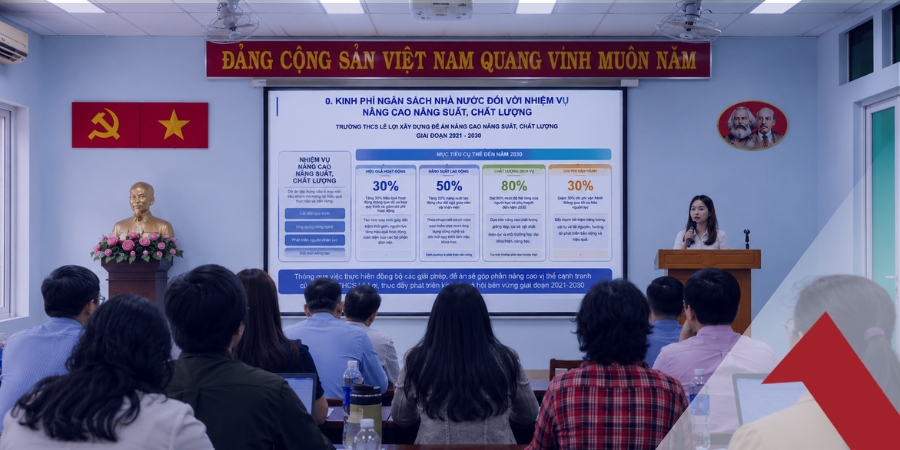
Funding Mechanisms and Support Levels for Selected Productivity and Quality Enhancement Initiatives
In some cases, as shared during the thematic session, the state budget may provide financial support at specified rates and subject to applicable conditions. In particular, support is available for testing and certification activities undertaken by enterprises manufacturing key export products, provided that they meet the relevant eligibility requirements.
Businesses should note that not all enterprises or certification activities are automatically eligible for financial support.
Eligible beneficiaries, supported activities, applicable conditions and support levels must be determined in accordance with the relevant programmes, calls for proposals, legal regulations and applicable sector-specific requirements.
Therefore, this is an opportune time for businesses to take proactive steps:
Explore Support Policies → Assess Needs → Identify Applicable Standards → Develop a Plan → Prepare Documentation → Implement the Management System → Undergo Assessment and Certification.
7. KMRA – Supporting Businesses from Initial Needs Assessment to Certification
For many businesses, the challenge is not simply becoming aware of ISO standards, but rather answering the question:
“Which standard is right for my business, and where should I start?”
This is precisely where KMRA aims to support businesses through guidance on selecting appropriate standards, as well as the assessment and certification of management systems within the registered scope.
KMRA can work alongside businesses to identify:
- Standards appropriate to their industry;
- The scope of certification;
- Requirements and preparations needed;
- The readiness level of their management systems;
- The implementation roadmap;
- Key considerations before the certification audit.
The objective is to help businesses gain a proper understanding of applicable standards, prepare in accordance with the relevant requirements and establish management systems suited to their actual operations.
8. Certification Services at KMRA
Depending on their industry and specific requirements, businesses can explore the following management system certification services:
Suitable for businesses seeking to standardize their quality management systems, control processes and improve the consistency of their products and services.
Supports businesses in establishing an environmental management system and controlling environmental aspects associated with their organizational activities.
Suitable for businesses seeking to establish an occupational health and safety management system.
Designed for organizations across the food chain that seek to establish a food safety management system.
Suitable for businesses that need to establish an information security management system and manage information-related risks.
Suitable for organizations operating in the medical device sector that seek to implement a quality management system in accordance with the relevant industry-specific standard.
Suitable for businesses operating within the automotive industry supply chain.
HACCP Certification and Related Standards
Supports businesses in the food sector in establishing and demonstrating systems for controlling food safety hazards in accordance with applicable programmes and standards.
9. Where Should Businesses Start?
If businesses are interested in productivity and quality improvement programmes or are planning to implement ISO standards, they can begin with the following five steps:
Step 1: Identify Existing Business Challenges
For example: inconsistent product quality, high defect rates, non-standardized processes, difficulties in controlling documentation or customer certification requirements.
Step 2: Define Objectives
Businesses should clearly identify their intended outcomes, such as improving quality, expanding into new markets, meeting customer requirements, participating in supply chains or standardizing management activities.
Step 3: Select the Appropriate Standard
The selected standard should align with the business's industry and actual operational objectives.
Step 4: Conduct a Gap Assessment
Determine the extent to which the business currently meets the applicable requirements and identify any remaining gaps.
Step 5: Establish and Evaluate the Management System
Once the management system has been implemented, the business can apply for a certification audit with an appropriate certification body.
10. Do Not Wait Until Customers Require ISO Certification to Get Started
One effective approach is for businesses to proactively standardize their operations before such requirements become mandatory in the market.
When customers or business partners require ISO certification, businesses with an established management foundation will have an advantage in terms of preparation time.
This is particularly important for businesses seeking to:
- Expand into new markets;
- Enter export markets;
- Participate in supply chains;
- Work with major customers;
- Enhance production capabilities;
- Standardize management and operational activities;
- Improve product quality;
- Strengthen brand credibility.
For these businesses, establishing a management system at an early stage can become a strategic investment.
11. KMRA – Turning Standards into Practical Business Value
Driven by the broader direction of innovation and productivity and quality enhancement, businesses can view standardization as a management tool rather than merely a certification requirement.
Standards help businesses achieve standardization.
Management systems enable businesses to maintain control.
Assessments help businesses identify areas for improvement.
Certification provides evidence of the conformity of management systems.
KMRA aims to be a trusted partner, supporting businesses throughout their journey of standardization, assessment and management capability enhancement, based on applicable standards and appropriate certification scopes.
If your business is exploring ISO certification, management systems or solutions to enhance productivity and quality, contact KMRA to receive guidance on selecting standards and certification scopes that best suit your actual needs.
KMRA – Partnering with Businesses on Their Journey Towards Standardzation and Quality Enhancement
For businesses interested in ISO certification or training, or requiring advice on selecting appropriate standards, please contact KMRA for professional support and a detailed quotation.
KMRA provides guidance on certification processes, assessment scopes, implementation timelines and costs tailored to the scale and industry of each business.
If you wish to register for ISO certification or training, or require advice on selecting the most suitable standard, please contact KMRA for assistance and a detailed quotation.
KMRA provides guidance on the certification process, audit scope, implementation timeline, and costs tailored to each organization's size and field of operation.
KMR VIETNAM COMPANY LIMITED
Ho Chi Minh City Head Office: ☎︎ +84 28 3535 4350 | Zalo: 0983 890 712 | support@kmra.vn
Hanoi Branch: ☎︎ Zalo: 0966 177 712 | support@kmra.vn
KMRA ACADEMY: ☎︎ Zalo: 0982 704 713 | cs002@kmra.vn
main.comment_read_more