
KMRA ACCOMPANIES CUSTOMERS THROUGH THE CERTIFICATION PROCESS FOR THE ISO 22000:2018 AND HACCP CODEX SYSTEMS OPERATING IN THE FOOD FLAVORINGS AND ADDITIVES INDUSTRY AT KIZUNA 3 INDUSTRIAL PARK – LONG AN
Recently, the KMRA team visited and worked with a customer operating in the production of flavorings and food additives at Kizuna 3 Industrial Park, Long An.
Throughout the process of accompanying businesses in the food industry and food supply chain, KMRA always places strong emphasis on understanding the actual production activities and specific operating conditions of each enterprise.
This is an important sector within the food supply chain. Flavorings and food additives are used in a wide range of products, from processed foods, beverages, and confectionery to industrial food products. Therefore, requirements for raw material control, production process control, hygiene conditions, hazard identification, and traceability are increasingly receiving attention from both businesses and their customers.
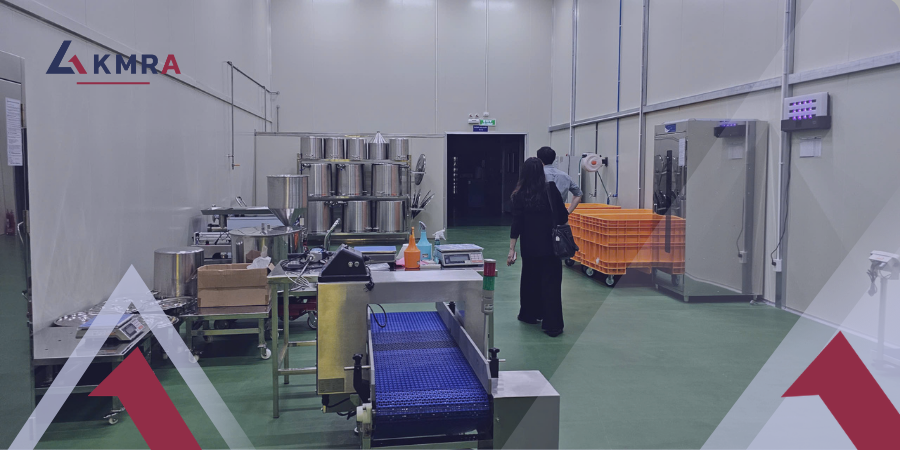
KMRA customer’s flavoring and food additive production areas
FLAVORING AND FOOD ADDITIVE PRODUCTION – FOOD SAFETY CONTROL CANNOT STOP AT FINISHED PRODUCT INSPECTION
For businesses manufacturing flavorings and food additives, ensuring food safety must be carried out throughout the entire process, from incoming raw materials to production, packaging, storage, and distribution.
A final product meeting requirements does not necessarily mean that the entire production process has been properly controlled. Businesses need to clearly identify factors that may affect food safety and establish appropriate control measures at each stage.
Some key issues that businesses need to pay particular attention to include:
- Controlling the origin and quality of incoming raw materials and additives.
- Evaluating and controlling suppliers.
- Controlling hygiene conditions of facilities, equipment, and production areas.
- Controlling the risk of cross-contamination between different raw materials and products.
- Controlling biological, chemical, and physical hazards.
- Controlling mixing, processing, packaging, and storage processes.
- Controlling identification, labeling, and traceability.
- Establishing methods for handling nonconforming products.
- Ensuring employees’ competence and awareness of food safety.
Therefore, HACCP CODEX and ISO 22000 certification are important tools that help businesses establish a systematic approach to food safety.
HACCP – THE FOUNDATION FOR HAZARD IDENTIFICATION AND CONTROL
HACCP (Hazard Analysis and Critical Control Points) is a preventive approach used to identify, assess, and control significant hazards related to food safety.
For businesses manufacturing flavorings and food additives, implementing HACCP helps them look at the entire production process from the perspective of: “Where can hazards arise, and how can they be controlled?”
The implementation of HACCP generally focuses on:
1. Hazard Analysis
Businesses need to identify hazards that may occur at each stage of production, including biological, chemical, and physical hazards.
2. Identification of Critical Control Points (CCPs)
Not every stage has the same level of risk. Businesses need to identify stages where control is essential to ensuring product safety.
3. Establishment of Critical Limits and Monitoring Methods
Critical limits and control methods must be appropriate to the characteristics of the product, production process, and actual operating conditions.
4. Establishment of Corrective Actions
When deviations occur, businesses must clearly define how to handle them in order to prevent unsafe products from continuing to be used or being released to the market.
5. Verification and Record Keeping
The HACCP system needs to be checked, verified, and supported by records to demonstrate that control measures are being effectively implemented.
The most important principle of HACCP is prevention rather than simply detecting errors after the product has been completed.
ISO 22000 – BUILDING A COMPREHENSIVE FOOD SAFETY MANAGEMENT SYSTEM
While HACCP CODEX focuses strongly on hazard analysis and control, ISO 22000 provides a broader framework for organizations to establish and maintain a Food Safety Management System (FSMS).
ISO 22000 enables businesses to combine HACCP principles with a management-system approach, thereby creating a system with clear responsibilities, control, evaluation, continual improvement, and maintenance.
For businesses manufacturing flavorings and food additives, an ISO 22000 system can support the control of several important areas, including:
Raw Material and Supplier Control
Businesses need to establish criteria for selecting, evaluating, and controlling suppliers to ensure that incoming materials meet defined requirements.
Production Condition Control
Prerequisite programs and hygiene conditions need to be established in accordance with the production environment, equipment, personnel, and specific characteristics of the products.
Hazard Control
Businesses identify, assess, and control food safety hazards throughout the entire process chain.
Traceability
The system needs to enable businesses to identify the origin of raw materials and the production history of products, supporting prompt action when issues arise.
Control of Nonconforming Products
When products or processes are found not to meet requirements, businesses need appropriate methods for identification, isolation, evaluation, and handling.
Evaluation and Improvement
Through internal audits, management reviews, data analysis, and corrective actions, businesses have a basis for continually improving the system.
ISO 22000 AND HACCP – NOT JUST “A CERTIFICATE”
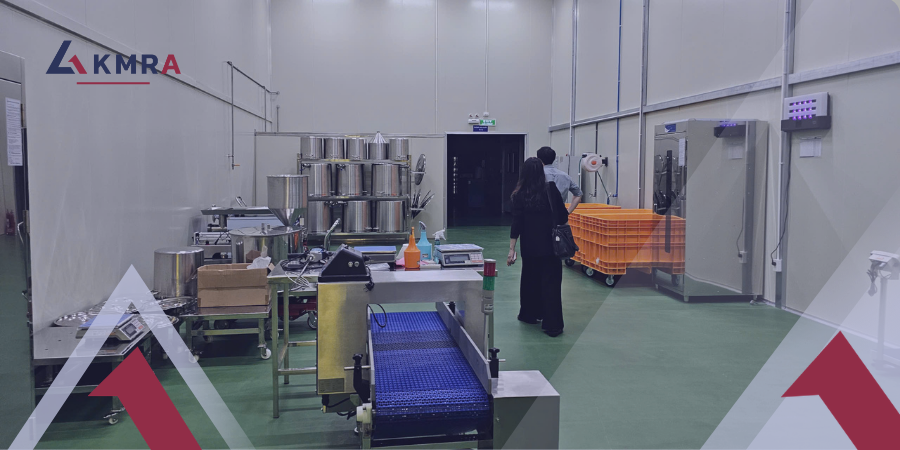
KMRA visits customers – connecting and accompanying businesses for development
In practice, many businesses initially pay attention to ISO 22000 and HACCP due to requirements from customers, partners, or the market. However, the greater value of the system lies in its ability to help businesses proactively and systematically control risks.
For the flavoring and food additive industry, this is even more significant because the products manufactured by businesses often become part of the raw materials used by other food manufacturers.
When customers select a supplier, they are not only concerned with whether the product meets requirements, but also with:
• How does the business control its products?
• How are raw materials controlled?
• Can products be traced when an incident occurs?
• How are hazards identified and controlled?
• Is the management system regularly maintained and improved?
A properly established ISO 22000 and HACCP system will help businesses provide clear answers to these issues.
KMRA – ACCOMPANYING BUSINESSES FROM REAL-WORLD PRACTICE
The customer visit at Kizuna 3 Industrial Park – Long An was also one of the activities demonstrating KMRA’s approach to working with businesses: not only focusing on documentation but also paying attention to actual operations.
Each business has different scales, products, technologies, processes, and levels of risk. Therefore, the development of an ISO 22000 and HACCP system needs to be considered based on the specific circumstances of each business, rather than mechanically applying the same set of documents.
Particularly in the flavoring and food additive manufacturing sector, correctly determining the certification scope, accurately describing production activities, and establishing appropriate control measures are important factors in ensuring that the system not only meets standard requirements but can also be effectively applied in practice.
KMRA aims to accompany businesses through each step:
On-site assessment → Scope determination → Hazard identification → System development → Implementation guidance → Assessment → Improvement → Certification and system maintenance.
The ultimate goal is not simply to achieve certification, but to help businesses establish a management system that is understandable – applicable – controllable – maintainable.
ISO 22000 & HACCP – AN IMPORTANT STEP TOWARD ENHANCING COMPETITIVENESS
As food safety requirements continue to receive increasing attention, establishing a food safety management system is becoming an important factor for businesses operating within the food supply chain.
For manufacturers of flavorings, food additives, and ingredients serving the food industry, ISO 22000 and HACCP not only support hazard control but also contribute to greater transparency, traceability, process stability, customer confidence, and sustainable development.
🤝 KMRA sincerely thanks the valued enterprise at Kizuna 3 Industrial Park – Long An for welcoming and taking the time to meet and exchange with the KMRA team.
We hope that these direct meetings at customers’ facilities will continue to serve as a bridge for KMRA to gain deeper insight into practical needs and provide more effective support to businesses throughout their journey toward quality improvement – risk control – food safety assurance – and sustainable development.
main.comment_read_more