
FROM THE TRAINING CONFERENCE ON RESPONSIBLE BUSINESS PRACTICES (RBP) TO THE NEED FOR ISO MANAGEMENT SYSTEMS IN BUSINESSES
On August 12, 2026, the Department of Legal Affairs under the Ministry of Science and Technology organized a training program in Ho Chi Minh City on the theme “Updates on Policies, Laws, and Practical Implementation of Responsible Business Practices in the Science and Technology Sector.”
Updates on RBP Policies, Laws and Practices – Key Directions for Businesses in 2026
Key Highlights from the RBP Training Program
The program focused on three main areas:
- Reviewing and updating policies and legal regulations related to Responsible Business Practices (RBP);
- Sharing practical experience in implementing RBP; and
- Discussion and exchange of views among participants.
Mr. Nguyễn Lê Đức Minh, M.Sc., from the Department of Legal Affairs under the Ministry of Science and Technology, delivered a presentation on updates to policies, laws, and practical implementation of Responsible Business Practices in the science and technology sector.
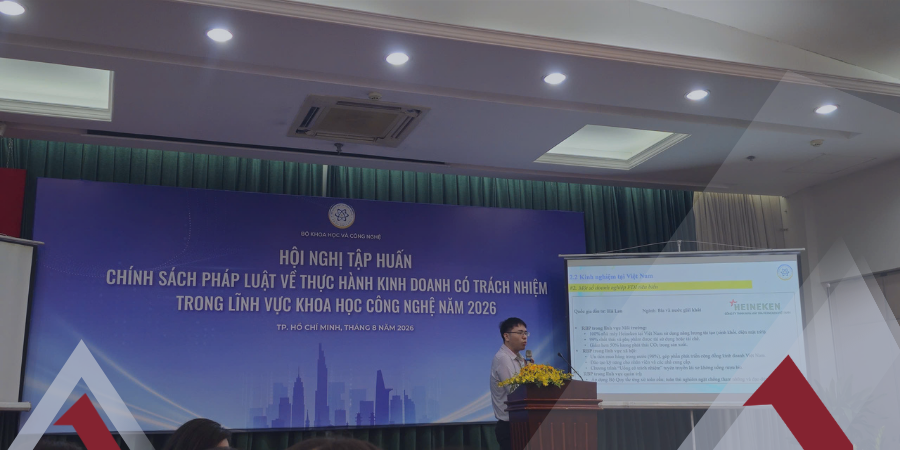
Mr. Minh shares insights at the conference on Responsible Business Practices (RBP).
This is a key message for businesses: responsible business practices are becoming increasingly closely linked to corporate governance, quality, environmental protection, labour, consumers, data, technology, and the ability to ensure regulatory compliance.
What Is RBP? – From Social Responsibility to Responsible Business Operations
Responsible Business Practices (RBP) refer to a business approach that requires organizations to operate in a sustainable, ethical, and socially responsible manner.
RBP goes beyond responsibility towards customers. It also covers employees, suppliers, business partners, communities, the environment, data and technology, intellectual property, standards and technical regulations, as well as risk management.
Four Key Pillars of RBP
Ethical responsibility: Research ethics, the responsible use of scientific and technological achievements, and the prevention of misuse.
Social responsibility: Using science and technology to serve communities, improve accessibility, and address social challenges.
Environmental responsibility: Reducing emissions, promoting green technologies, and complying with environmental standards and technical regulations.
Governance responsibility: Ensuring data transparency, managing technological risks, and controlling testing and experimental activities.
Why Should Businesses Start Paying Attention to RBP Now?
Businesses are increasingly expected to demonstrate not only what they do, but also how they do it. Issues relating to raw materials, suppliers, production conditions, employees, waste, energy, safety, traceability, data, and regulatory compliance can all become part of a company’s competitive capability.
From RBP to ISO 9001: Building a Foundation for Responsible Management
ISO 9001:2015 helps businesses establish a process-based quality management system, manage risks, control operations, and pursue continual improvement.
Key areas that support RBP include process control, defined responsibilities, product and service quality, supplier management, customer satisfaction, nonconformity management, and continual improvement.
RBP and ISO 14001: Environmental Responsibility
ISO 14001:2015 — the Environmental Management System standard — helps businesses identify environmental aspects, assess impacts, control waste, use resources and energy efficiently, comply with applicable legal requirements, and continually improve environmental performance.
RBP and ISO 45001: Responsibility Towards Employees
ISO 45001:2018 helps businesses identify hazards, assess risks, control working conditions, prevent workplace accidents, raise awareness, strengthen employee participation, and achieve continual improvement.
RBP and ISO 22000: Responsibility for Consumer Protection
For the food industry, responsible business practices are clearly reflected in food safety. ISO 22000:2018 and HACCP support the control of hazards, raw materials, suppliers, production processes, traceability, and nonconforming products.
RBP in the Digital Era – The Role of ISO/IEC 27001
As digital transformation accelerates, data and technology have become increasingly important aspects of corporate governance. ISO/IEC 27001:2022 helps businesses manage information security risks, control access rights, protect data, manage incidents, and address risks arising from third parties.
RBP Across the Supply Chain
RBP should be viewed beyond the boundaries of an organization. Businesses need to consider suppliers, raw materials, production, distribution, and customers. ISO management systems can support the establishment of criteria for supplier selection, evaluation, and control.
ISO 26000 – A Bridge Between RBP and Social Responsibility
ISO 26000 provides guidance to organizations on organizational governance, human rights, labour practices, the environment, fair operating practices, consumer issues, and community involvement and development.
Note: ISO 26000 is a guidance standard on social responsibility. It is not a certifiable management system standard in the same way as ISO 9001, ISO 14001, or ISO 45001.
Not Every Business Needs All ISO Standards
The selection of standards should be based on the organization’s industry, products or services, risks, customer requirements, legal requirements, and development objectives.
Businesses may implement a single standard or integrate multiple management systems where appropriate.
What Does ISO Certification Mean for Responsible Business Practices?
RBP raises an important question: If a business claims to be responsible, how can it demonstrate that responsibility in practice?
ISO management systems help businesses demonstrate this through policies, objectives, processes, assigned responsibilities, documented information, controls, audits, corrective actions, and continual improvement.
ISO certification should not be viewed simply as a certificate on the wall, but rather as the outcome of an organization establishing and maintaining a structured management system.
KMRA – Supporting Businesses from Standards to Certification
KMRA aims to help businesses identify and adopt certification standards that are appropriate to their specific operations, rather than applying standards unnecessarily or on a one-size-fits-all basis.
Key standards and management systems include ISO 9001, ISO 14001, ISO 45001, ISO 22000, HACCP, ISO/IEC 27001, ISO 13485, IATF 16949, ISO/IEC 20000-1, ISO 37001, and ISO 37301.
From “Responsible Business” to a “Systematic Organization”
Responsibility should not remain merely a commitment — it needs to be embedded into the management system.
Businesses can start by asking key questions about quality, environmental performance, occupational safety, product safety, data protection, suppliers, and regulatory compliance.
If there are no clear answers, establishing an appropriate ISO management system may be an essential next step.
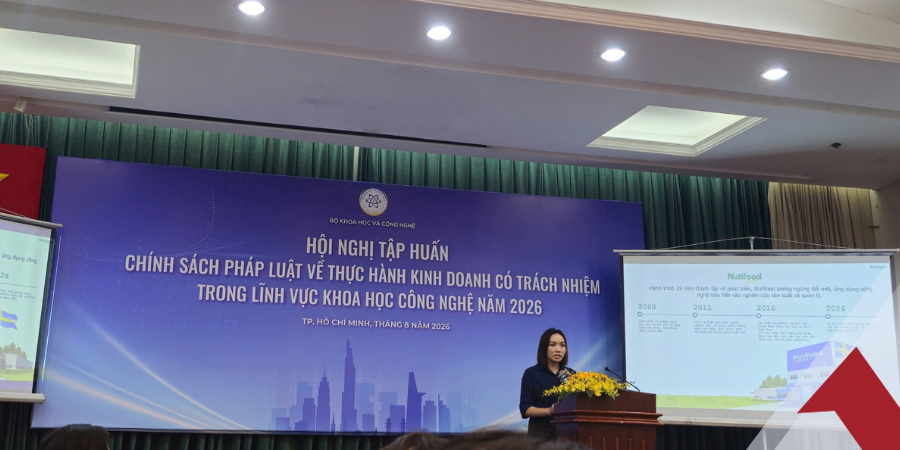
A Business Representative Shares Practical Experience in Responsible Business Practices (RBP)
RBP Will Increasingly Become Part of Business Competitiveness
The training program on Responsible Business Practices in the science and technology sector highlights how business activities are increasingly viewed in relation to law, ethics, the environment, employees, consumers, technology, and governance.
Businesses with well-established management systems are better positioned to manage risks, ensure compliance, improve quality, protect employees, safeguard the environment, meet customer expectations, participate in supply chains, and pursue sustainable growth.
RBP provides a framework for responsible business conduct. ISO standards provide practical tools for managing and controlling these responsibilities. ISO certification gives businesses a basis for demonstrating that their management system has been independently assessed against the applicable standard.
KMRA – Supporting Businesses in Building Effective Management Systems
KMRA supports businesses in developing management systems that are appropriate to their operations, strengthening competitiveness, and advancing sustainable development.
Are you looking for ISO 9001, ISO 14001, ISO 45001, ISO 22000, HACCP, ISO 27001, or another management system standard? Contact KMRA for advice on the most appropriate standard, scope, and certification roadmap for your actual business operations.
Reference Table: RBP and Relevant Certification Standards
|
Business Requirement |
Relevant Standard |
|
Quality Management |
ISO 9001:2015 |
|
Environmental Management |
ISO 14001:2015 |
|
Occupational Health & Safety |
ISO 45001:2018 |
|
ISO 45001:2018 |
ISO 22000:2018 / HACCP |
|
Information Security |
ISO/IEC 27001:2022 |
|
Medical Devices |
ISO 13485 |
|
Energy Management |
ISO 50001 |
|
Anti-Bribery Management |
ISO 37001 |
|
Compliance Management |
ISO 37301 |
|
Social Responsibility |
ISO 26000 – Guidance |
main.comment_read_more