Is your organization facing these challenges?
Many manufacturing businesses that are implementing or preparing to implement IATF 16949 often face challenges in effectively applying the core quality tools.
✓ Lack of a clear understanding of the purpose and application of each Core Tool
✓ APQP and PPAP documentation has been developed but does not fully meet customer requirements
✓ FMEA is not effectively used for risk prevention
✓ SPC data is not fully utilized to control production processes
✓ Measurement systems have not been evaluated for reliability through MSA
✓ Difficulties in preparing for and responding to customer or certification body audits
KMRA’s training course is designed to directly address these challenges, helping businesses strengthen their quality management capabilities and meet the requirements of the automotive industry.
What value does the course bring to your organization?
Build a Competent Internal Audit Team
Equip your team with foundational and advanced knowledge of core tools used in automotive quality management systems.
Reduce Product Risks and Defects
Help businesses proactively identify, assess, and control risks throughout the design and manufacturing processes.
Improve Process Control Effectiveness
Apply SPC and Control Plan to monitor production processes, reduce defect rates, and minimize waste.
Meet Customer and IATF 16949 Requirements
Support businesses in developing quality documentation that meets the requirements of OEM and Tier 1 customers.
Strengthen Competitiveness
Enhance business credibility and expand opportunities to participate in the global automotive supply chain.
Who should attend?
The course is suitable for:
- Members of the IATF 16949 team
- Quality Assurance/Quality Control (QA/QC) Managers and Deputy Managers
- Quality Engineers
- Production Engineers
- Product Design Engineers
- Personnel responsible for APQP, PPAP, FMEA, SPC, and MSA
- Automotive parts manufacturers and supporting industries
- Organizations that are developing or maintaining an IATF 16949 management system
Training program content
|
DATE |
COURSE CONTENT |
|
DAY 1 From 08:30 AM to 04:30 PM |
I. OVERVIEW & APQP 1. Overview of the 6 CORE TOOLS Role of the 6 Core Tools in the automotive supply chain Relationship between the 6 Core Tools and IATF 16949 requirements Overview of the interrelationship among the 6 Core Tools throughout the product life cycle 2. APQP (Advanced Product Quality Planning) Customer information and requirements for new products/components Introduction to the APQP implementation process Overview of the stages for new product/component approval Requirements for each stage Product/Component Approval Process Developing a Quality Control Plan *Case Study: Developing an APQP Plan for a Sample Product |
|
DAY 2 From 08:30 AM to 04:30 PM |
II. PROCESS DEVELOPMENT & FMEA 1. Process Flow Diagram Developing a manufacturing process flow diagram Identifying the input and output of each process step 2. FMEA (Failure Mode and Effects Analysis) Identifying and analyzing potential failures in the manufacturing process Introduction to the FMEA implementation process Identifying potential failure modes at each process step Establishing criteria for evaluating the severity of failure modes Reviewing and evaluating risk levels for each process step *Case Study / Practical Exercise: Developing a PFMEA based on a real-world manufacturing process |
|
DAY 3 From 08:30 AM to 04:30 PM |
III. CONTROL & MEASUREMENT 1. Control Plan Purpose and role in production control Classification of Control Plans by product development stage Linking the Control Plan with PFMEA and Process Flow Developing control methods and reaction plans Updating the Control Plan when process changes occur 2. MSA (Measurement System Analysis) Evaluating measurement systems Determining the repeatability and reproducibility of measurement equipment Evaluating measurement system capability (Cpk) Practical measurement equipment evaluation *Case Study/ Practical Exercise: Evaluating a measurement system 3. SPC (Statistical Process Control) Collecting and evaluating process performance data in manufacturing operations Sampling methods and lot evaluation Determining process distribution Determining process control levels Reading and interpreting control charts Calculating process capability (Cpk) and defect rate (PPM) *Case Study / Practical Exercise: SPC Data Analysis |
|
DAY 4 From 08:30 AM to 04:30 PM |
PPAP & INTEGRATION PPAP (Production Part Approval Process) Communicating with customers and meeting customer requirements Customer-specific requirements PPAP submission levels PPAP submission status and part submission status Case Study/ Practical Exercise: PPAP Submission Case Study Integration – Linking the 6 CORE TOOLS Implementation Sequence: Customer Requirements → APQP → Process Flow → PFMEA → Control Plan → MSA & SPC → PPAP Final Case Study: Developing a complete quality documentation package for a sample product Review & Final Course Assessment Comprehensive review of key knowledge and core concepts Discussion of real-world situations and challenges in the workplace Final course assessment (Multiple-choice questions + short case scenarios) |
Part 1: Overview of the 6 Core Tools
- Role of the 6 Core Tools within the IATF 16949 quality management system
- Interrelationship among the Core Tools
- Customer-specific requirements and standard requirements
Part 2: APQP – Advanced Product Quality Planning
- Product quality planning phases
- Identifying customer requirements
- Developing product development plans
- Project schedule management
Part 3: PPAP – Production Part Approval Process
- Purpose and requirements of PPAP
- PPAP submission levels
- PPAP records and documentation
- Product approval process
Part 4: FMEA – Failure Mode and Effects Analysis
- DFMEA and PFMEA methodologies
- Identifying failure modes
- Assessing risk levels
- Developing preventive actions
Part 5: SPC – Statistical Process Control
- Principles of statistical process control
- Control charts
- Assessing process capability (Cp, Cpk)
- Production data analysis
Part 6: MSA – Measurement System Analysis
- Types of measurement errors
- Gage R&R analysis
- Evaluating measurement system stability and accuracy
- Practical MSA evaluation
Part 7: Control Plan
- Developing a Control Plan
- Linking the Control Plan with FMEA and SPC
- Controlling critical characteristics
- Updating and improving the Control Plan
Part 8: Practical Exercises and Case Studies
- Developing practical Core Tools documentation
- Analyzing real-world business cases
- Discussing common implementation issues
- Guidance on practical implementation
Course Information
|
Course Outline |
Details |
|
Duration |
04 days |
|
Training Format |
On-site or Online |
|
Training Location |
At the Client's Site or Online (as requested by the client) |
|
Language |
Vietnamese |
|
Certificate |
Certificate of Completion |
|
Documentation |
Complete 6 Core Tools Training Materials |
Why Organizations Choose KMRA
Practical Experience in Certification Auditing
Our instructors have many years of experience in consulting, training, and auditing quality management systems in the automotive industry.
Business-Focused Training Content
The training focuses on practical application to the company’s products, processes, and quality documentation.
Flexible Training Options
- On-site training at your company
- Online training
- Public training courses
Post-Training Support
Consultation and support to help businesses address challenges encountered during the implementation of the 6 Core Tools.
What is 6 Core Tools?
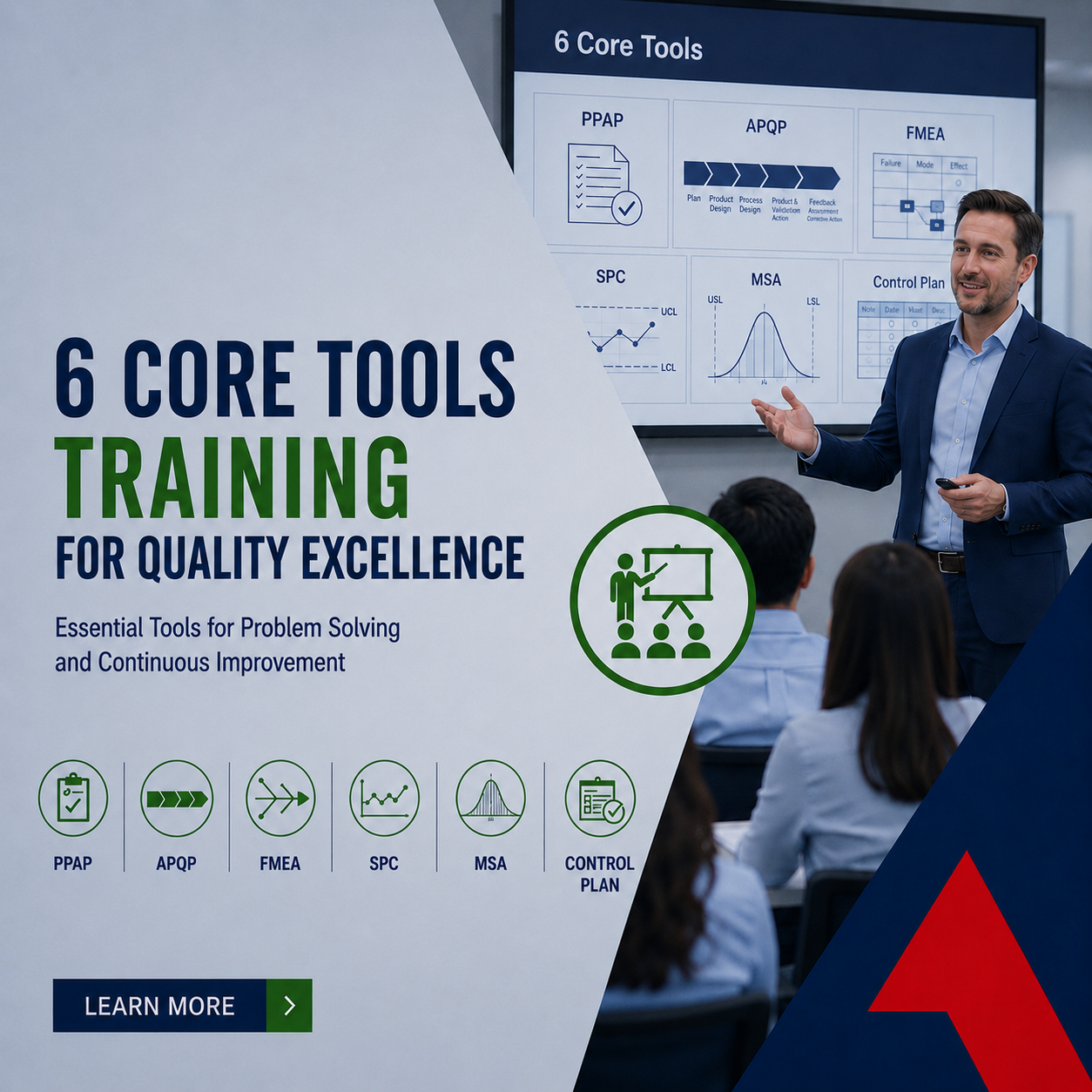
The 6 Core Tools are a set of essential quality tools widely used in the global automotive industry to control product quality and manufacturing processes. They provide an important foundation for businesses to meet IATF 16949 requirements and customer requirements throughout the automotive supply chain.
The 6 Core Tools include:
- APQP – Advanced Product Quality Planning
- PPAP – Production Part Approval Process
- FMEA – Failure Mode and Effects Analysis
- SPC – Statistical Process Control
- MSA – Measurement System Analysis
- Control Plan – Quality Control Plan
Benefits of Implementing the 6 Core Tools
- Reduce product defects and customer complaints
- Improve process control capabilities
- Prevent risks from the early design stage
- Ensure the stability and reliability of measurement systems
- Meet IATF 16949 and OEM customer requirements
- Improve production efficiency and reduce quality costs
- Strengthen the competitiveness of the business
Key Figures
More than 1,000 organizations have trusted KMRA's expert team for training, certification, and management system auditing services.
Frequently Asked Questions (FAQs)
1. What tools are included in the 6 Core Tools?
The 6 Core Tools include APQP, PPAP, FMEA, MSA, SPC, and Control Plan. These are core quality management tools that help businesses prevent defects, control processes, and meet the requirements of the automotive industry.
2. Are the 6 Core Tools mandatory under IATF 16949?
Yes. Although IATF 16949 does not have a separate clause specifically dedicated to the 6 Core Tools, these tools are required through various requirements of the standard and customer-specific requirements in the automotive industry.
3. Who should attend the 6 Core Tools training course?
The course is suitable for business leaders, production managers, QA/QC personnel, quality engineers, process engineers, SQEs, members of the IATF 16949 team, and professionals working in the automotive and automotive supporting industries.
4. How long does the 6 Core Tools training course last?
The standard training program typically lasts 3–4 days. For advanced programs or on-site training, the duration can be customized according to the business's specific needs.
5. What is the relationship between the 6 Core Tools and IATF 16949?
The 6 Core Tools are methods that support businesses in effectively implementing a quality management system according to IATF 16949. They help control risks, improve product quality, and meet customer requirements in the automotive industry.
6. Will participants receive a certificate after completing the course?
Yes. Participants who successfully complete the full training program will receive a KMRA Certificate of Completion for the 6 Core Tools Training Course, confirming their participation and completion of the course.
Register for 6 Core Tools Training
KMRA provides AIAG-based 6 Core Tools Training, covering APQP, PPAP, FMEA, MSA, SPC, and Control Plan, tailored to the needs of businesses in the automotive and supporting industries.
We develop training programs customized to each business’s products, manufacturing processes, size, and specific requirements.
✓ Receive a detailed training outline
✓ Get a training course quotation
✓ Receive consultation on the most suitable training program
✓ On-site training available nationwide